Types of Foundation Bolts and Where Each One Is Used
A foundation bolt has one job: to carry load out of a steel base plate and into concrete without pulling out, and without moving. Every difference between the types below comes from one question — how does this particular bolt transfer its load into the concrete? Answer that, and the right type usually picks itself.
How a foundation bolt actually holds
An embedded bolt resists tension in one of three ways. It can rely on the bond between steel and concrete along its embedded length. It can rely on a hook or bend that has to straighten before the bolt can escape. Or it can rely on a plate, head or nut at the bottom that has to crush or break a cone of concrete before it moves.
Those three mechanisms are not equal. Bond alone is unreliable and is not counted on in design. A hook adds resistance, but a hook can straighten under high tension, which is why hooked anchors are limited in modern anchorage design and are being replaced on heavily loaded connections. A plate or nut at the embedded end is the most predictable of the three, because the failure it has to overcome is a concrete breakout cone, which an engineer can calculate.
Read the types below in that order and the pattern is clear: as loads rise, the industry moves from hooks to heads and plates.
1. J-type foundation bolt
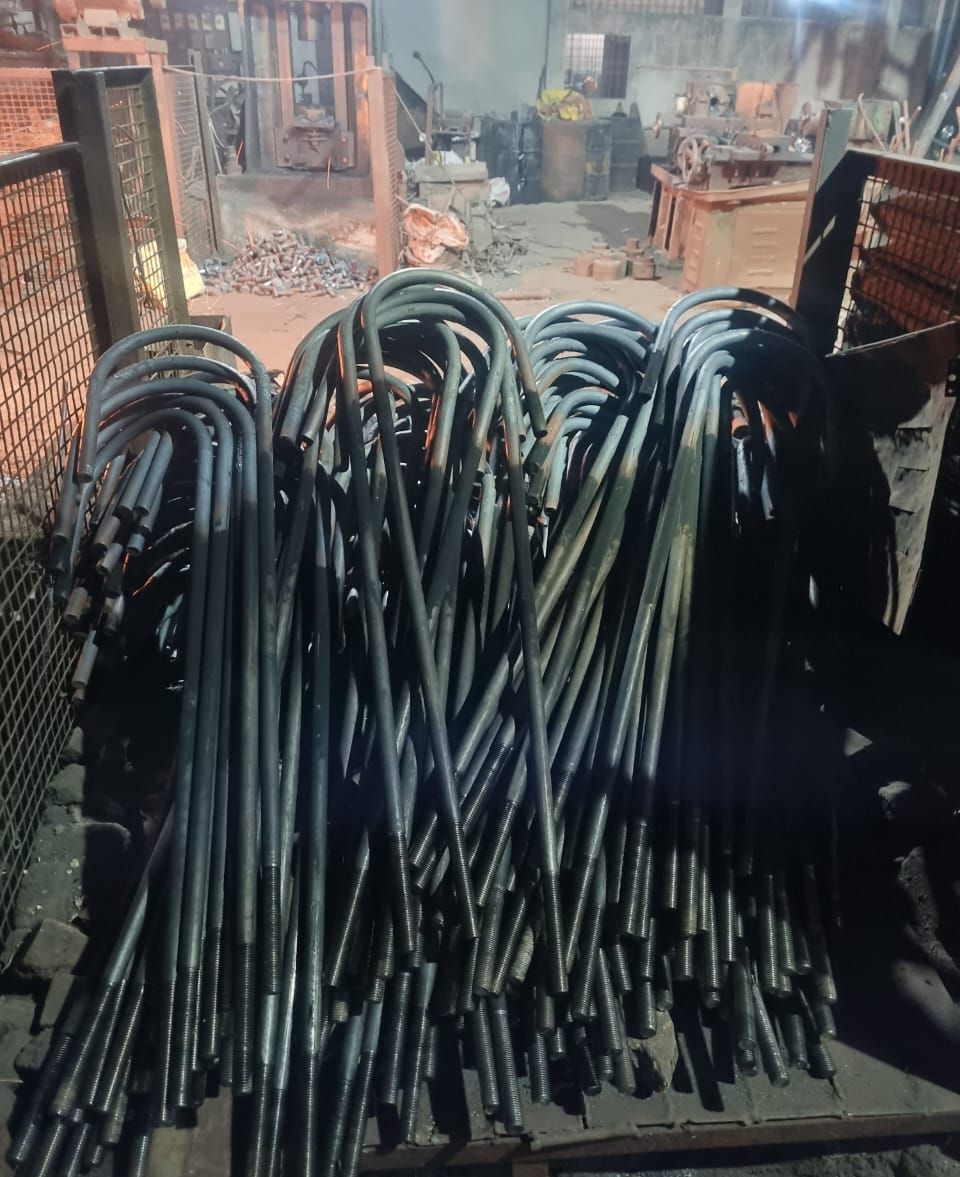
A straight rod threaded at the top with a long curved hook at the embedded end. It is the most common foundation bolt in general construction and the cheapest to make, because the bend needs no welding and no additional parts.
Where it is used: light to moderately loaded base plates — equipment skids, pumps, small machinery, boundary structures, light poles, and holding-down duty where the bolt is mainly locating the plate rather than resisting large uplift.
What to watch: the hook radius matters. Bent too tight, the outer fibre of the bar is damaged and the bolt can crack at the bend, either during bending or later in service.
2. L-type foundation bolt
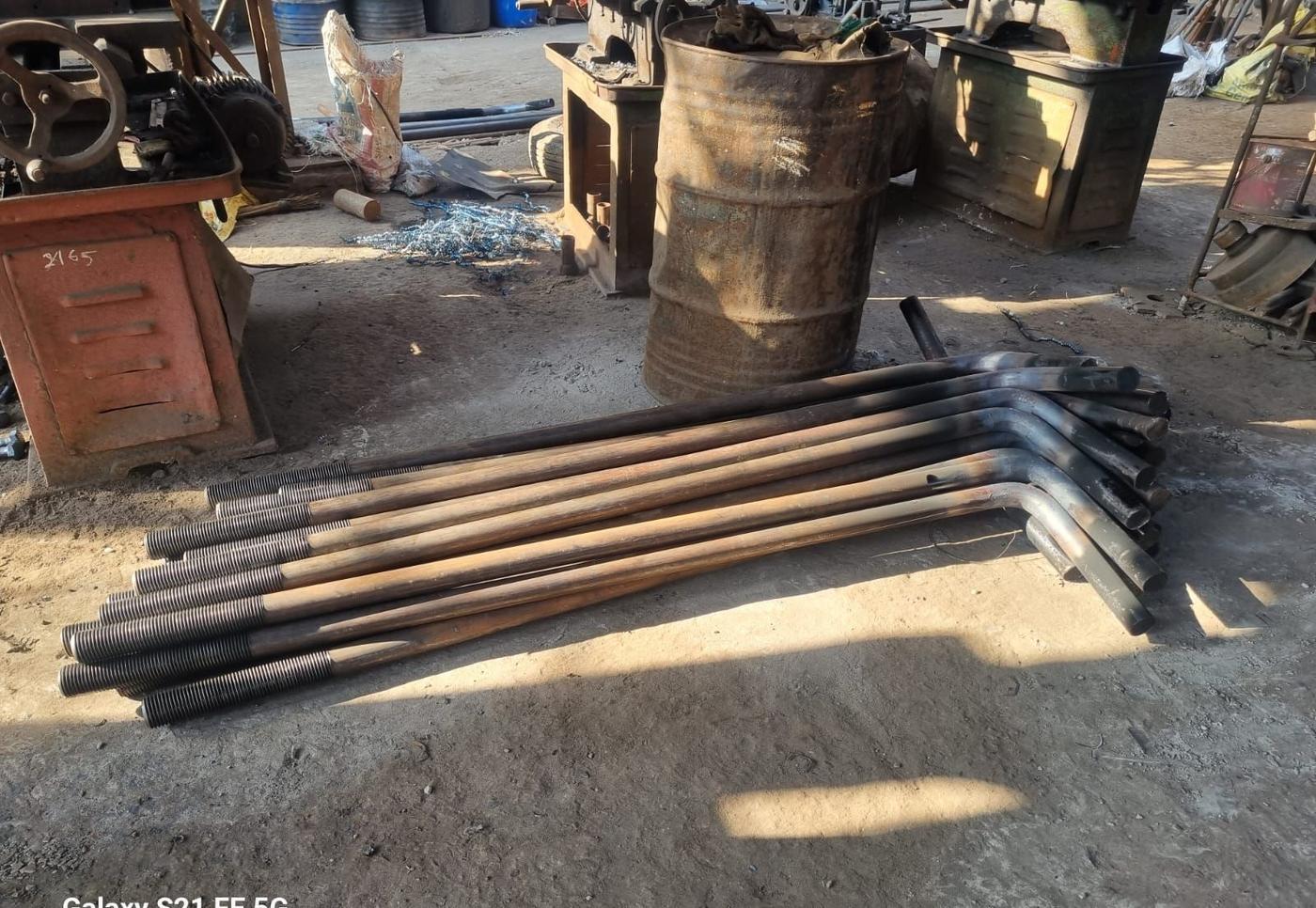
The same idea with a square 90° leg instead of a curved hook. Simpler to bend and slightly easier to position in shuttering, but it develops less resistance than a J-hook of the same bar size because the leg is shorter and straightens more readily.
Where it is used: the same duty as a J-bolt, and often chosen for reasons of formwork clearance rather than strength — where a long curved hook would foul reinforcement, an L leg fits.
3. Straight anchor rod with nut and plate washer
A plain threaded rod, threaded at both ends, with a heavy hex nut and a square or round plate washer assembled at the embedded end. The nut and plate do the work that a hook does on a J-bolt, and they do it more predictably.
Where it is used: this has become the standard detail for structural steel column bases, moment connections, and anything an engineer has designed to a concrete breakout calculation. Where a project specifies ASTM F1554 anchor rods, this is usually the article being asked for.
Practical note: the top end normally carries a longer thread than the bottom, because the top has to absorb setting-out error, grout thickness, levelling nuts and the base plate itself. It is completely normal for the two ends of the same bolt to carry very different thread lengths — 500 mm at the top and 100 mm at the bottom, for instance. Say so on the drawing; do not assume the maker will guess.
4. Eye-end anchor rod
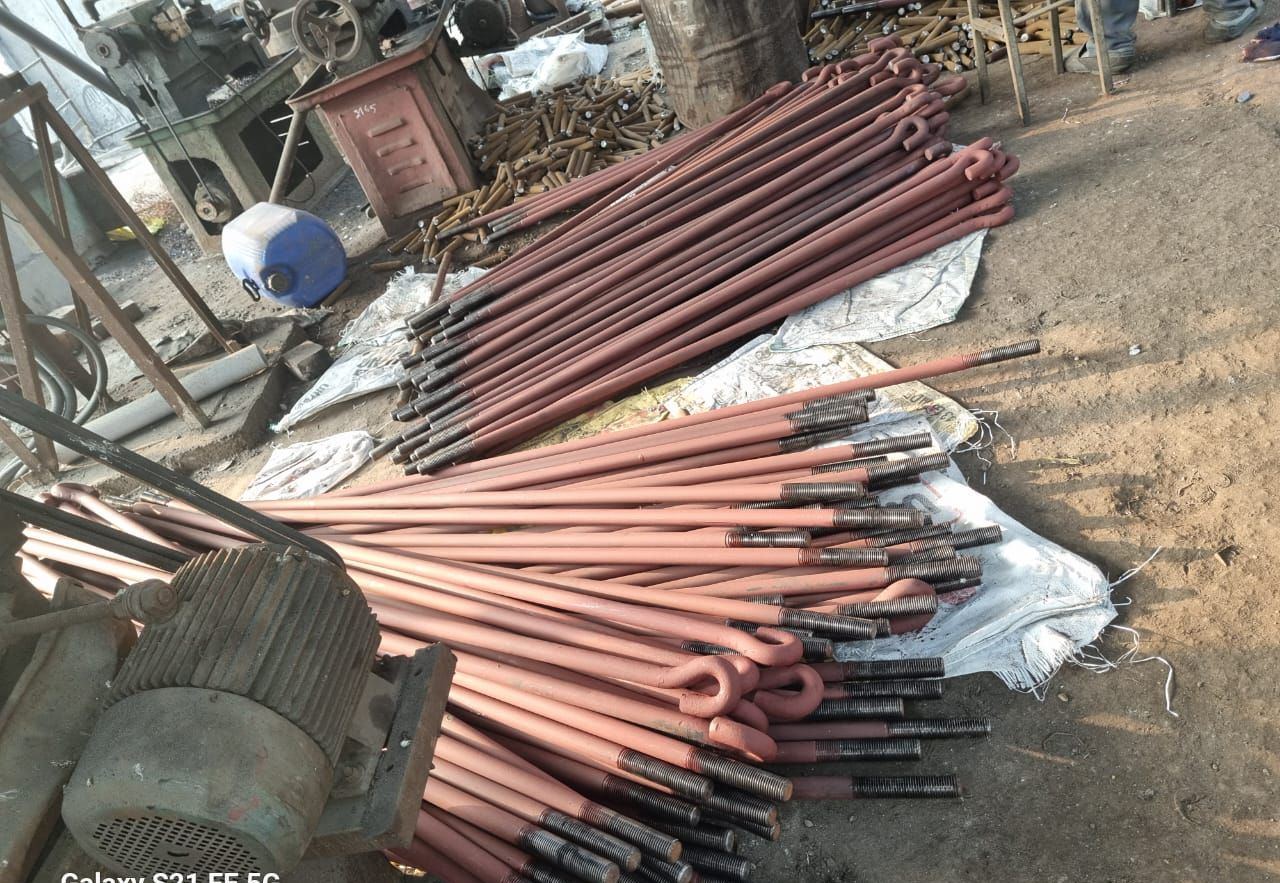
A closed loop is formed at the embedded end instead of a hook. A bar can be passed through the eye so the anchor is tied directly into the reinforcement cage, turning the anchorage into a mechanical connection with the reinforcement rather than a hook relying on the concrete alone.
Where it is used: anchoring into congested reinforcement, retaining structures, and tie-back or guy applications.
5. Welded plate foundation bolt assembly
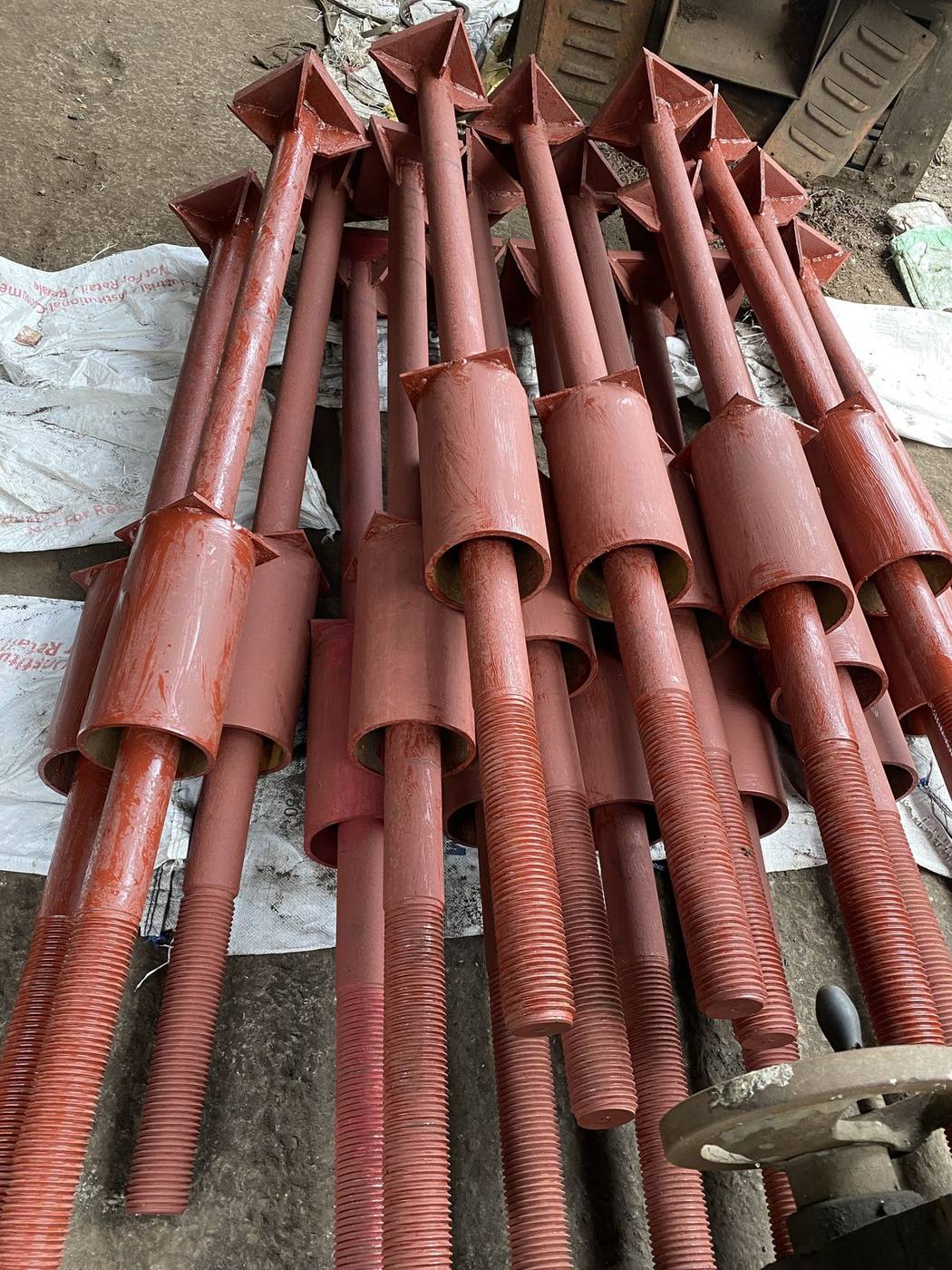
The heaviest of the family and the one that needs real fabrication rather than just bending. A base plate is welded square to the bottom of the rod, and triangular stiffener gussets are welded between the rod and the plate so the weld is not carrying the load in bending on its own. The result is an anchor whose pull-out resistance comes from a defined plate area, not from a hook that might straighten.
Three features cause most of the confusion during enquiry:
- The stiffener gussets. Small triangular plates welded between rod and base plate. They stop the connection failing by bending the plate around the rod. On any seriously loaded assembly they are not optional.
- The pipe sleeve. A short pipe welded at mid-section, just below the threaded portion, usually seated on a small plate. It leaves the upper part of the bolt free to flex, which is what allows the bolt to be pulled slightly out of position on site to meet the base plate holes. Customers normally call up the pipe by nominal bore and class; we buy and cut it by outside diameter and wall thickness, so give both if you can.
- The tuck nut. A nut one size above the rod, bored oversize and welded low on the shank rather than threaded on — a 36 size nut bored to 33 for a 32 mm rod, for example. It gives a positive mechanical stop at depth without needing thread at the bottom of the bolt.
Where it is used: heavy machinery foundations, crane rails, tower and mast bases, transfer columns, and any base plate where uplift is a designed load rather than an incidental one.
6. U-bolt and two-legged holding down bolts
A single bar bent into a U with both ends threaded, or two rods tied by a common plate. Both legs are embedded, so the anchor resists uplift on two lines and resists rotation as well as pull. Used for straddling an embedded member, clamping down rails and pipework, and machine bases where the bolt must also stop the plate from twisting.
7. Anchors with mechanical keying
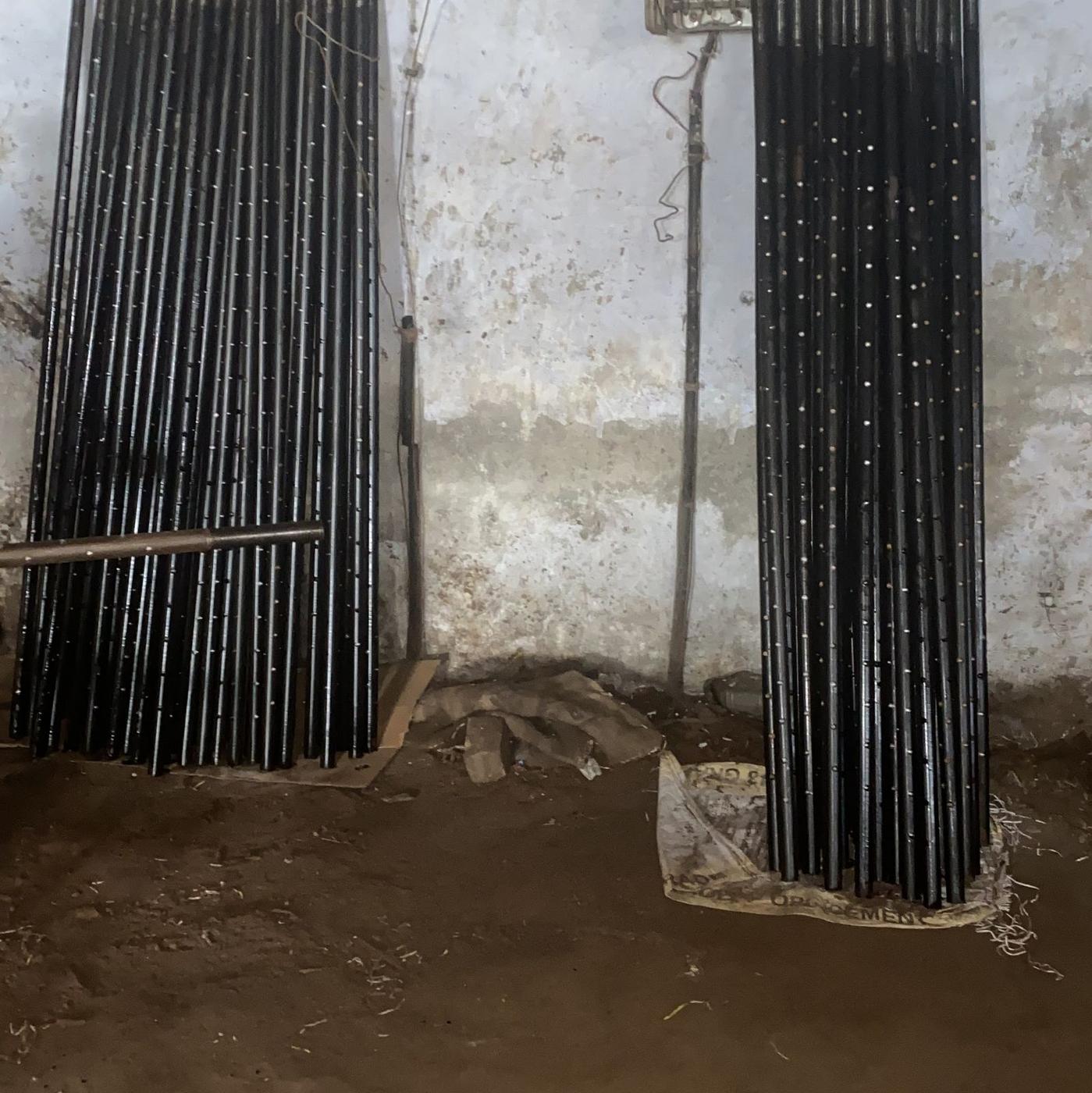
Where the design wants bond along the whole embedded length rather than resistance concentrated at one hook or plate, the rod itself can be deformed. Swaged rods achieve this by upsetting the bar. Another route, which we have supplied for a road over bridge foundation, is to drill shallow blind pockets — around 5 mm deep — at intervals along the embedded length, so concrete flows into them and keys mechanically to the rod instead of relying on the bond to a smooth bar.
Grades, and how a bent bolt gets its properties
Foundation bolts are supplied across a wide range of strengths, and the grade interacts with the shape. Lower strength carbon steel bends readily. Higher tensile and heat-treated grades are stronger but far less tolerant of being bent once hardened, which is why several standards restrict bent anchors to lower grades — ASTM F1554 permits bent rods in Grade 36 and Grade 55, but not in Grade 105, which is made straight with a nut or plate at the embedded end.
That restriction is about bending hardened material, not about what a bent anchor can ultimately achieve. The way round it is sequence.
Bend first, heat treat afterwards. At S R Forgings the bend is formed before heat treatment, so the bar is never bent in a hardened condition and the radius is not being asked to survive a bend it cannot take. Properties are developed afterwards, across the whole finished part. This is how we supply bent anchors in property classes 8.8 and 10.9 rather than only in mild steel — including M56 L-bolts in class 10.9 supplied for a high speed rail project.
Heat treatment is carried out at our heat treatment partner in a 2 metre deep pit-type gas-fired furnace, with bolts hung vertically through the cycle. The parts are through hardened — quenched and tempered so properties develop across the full section — not case hardened. The vertical hang matters more than it sounds: a long bar supported horizontally cools unevenly along its length and comes out of the quench bent. Hanging it removes that.
On testing, the heat treatment facility tests two pieces per lot and issues results. We then draw two further pieces at random from the same lot and send them to a NABL-accredited laboratory for independent verification. Results have matched in every lot to date. NABL accreditation is internationally recognised through mutual recognition arrangements, so those reports are accepted in export markets without re-testing.
Standards commonly called up
IS 5624 and DIN 529 cover foundation and masonry bolt types; ASTM F1554 covers anchor rods and is the one most often named on export projects. Where a project calls up one of these, quote against it rather than against a generic description — the type designations inside each standard fix the shape, the grade and the tolerances together.
How to specify without going back and forth
- Type — J, L, straight with nut and plate, eye, welded plate assembly, or U
- Nominal diameter and total developed length of the bar
- Thread length at each end, separately, and thread form
- Steel grade or property class, and the standard it is to be tested against
- For bent types: hook or leg length, and bend radius if it is specified
- For plate assemblies: base plate size and thickness, gusset detail, sleeve size, and whether a tuck nut is required
- Nuts and washers — how many per bolt, and to which standard
- Finish — self colour, red oxide primer, black, or hot dip galvanised
- Quantity, and whether assemblies are to be supplied fitted or loose
One note on weight and pricing, since it comes up on nearly every order: foundation bolts are billed on the nominal diameter over the full length of the bar. The material removed in cutting the thread is not deducted. That is standard practice across the industry and worth knowing before comparing two quotes that look different.
What we manufacture
S R Forgings manufactures foundation and anchor bolts at Focal Point, Ludhiana in all the types above, in diameters up to 110 mm and in quantity up to 3750 mm long, to the customer's drawing or to the standard called up in the specification. Welded plate assemblies are built in-house complete with base plates, stiffener gussets, sleeves and tuck nuts, and supplied with matched nuts and washers.
If you are still sizing the bolt, our foundation and anchor bolt weight calculator will give you the weight for straight and welded plate types before you commit to a design. More photographs of parts made here are in the product gallery. Send us a drawing or a marked-up sketch and we will quote against it.