Tunnel Segment Bolts: Thread Form, Types and How to Specify Them
Behind every tunnel boring machine, a ring of precast concrete segments is assembled and bolted together, one ring after another, for the length of the drive. The bolts that hold those rings are unlike anything else in structural fastening — and they are ordered in enormous quantities, because every ring needs a full set and a metro drive needs thousands of rings.
If you are procuring for a metro or a water tunnel package, this is what those bolts are and what a drawing needs to say.
What the bolts actually do
A tunnel lining ring is made of precast segments — typically five to eight plus a smaller key segment. Two sets of bolts hold it together:
Radial bolts join segment to segment within one ring, across the longitudinal joints. They pull the segments together so the ring closes properly and the joint gaskets compress to seal.
Circumferential bolts join each new ring to the ring already built, across the circle joint. They hold the ring in position while the machine shoves forward off it, and keep the gasket compressed until the annulus grout has set.
Alongside them a ring may use dowels, guiding rods and shear pins, which locate segments without threading.
The critical point about the load case: much of the work these bolts do is temporary. They hold everything in place during erection, gasket compression and grouting. Once the grout has set and the ground has loaded the lining, the ring is largely self-supporting in compression. On many projects the radial bolts are removed after the ring is complete and re-used further up the drive. The circumferential bolts usually stay.
That is why the specification for these bolts looks so different from structural bolting. They are assembly tools as much as permanent fasteners.
The thread is coarse, and that is the whole point
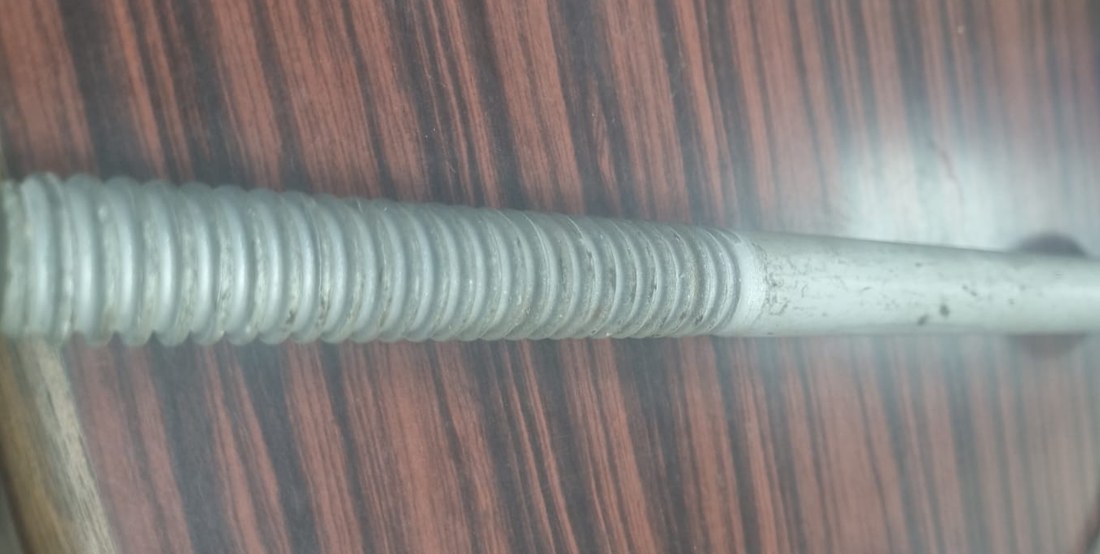
The thread on a tunnel segment bolt is not ISO metric coarse. It is a broad trapezoidal form on a 5 mm pitch — against the 3 mm an M24 ISO coarse thread would carry. Fewer threads per unit length, and each one much stouter.
There are four reasons, and they all come from the working conditions inside a TBM.
Speed. Fewer turns to full engagement. When a crew is bolting a ring every twenty minutes for months, the number of turns per bolt is a real cost.
Dirt tolerance. The environment is wet, gritty and full of grout. A fine thread packs with debris and seizes. A coarse trapezoidal thread has wide, open flanks that push muck out of the way rather than jamming on it.
Damage tolerance. These bolts are handled roughly, dropped, and often re-used. A coarse thread with a broad flank survives knocks that would flatten a fine crest and make the bolt unusable.
Misalignment tolerance. Segments are not always in perfect line when a bolt is started. The coarse form starts more readily into a socket that is slightly off.
The load case allows it. These are not preloaded friction grip connections; they are clamping the joint and compressing a gasket, so the fine thread's advantages in tension and vibration resistance simply do not apply here.
A note on naming. The fastener trade in India calls this thread ACME, and it does look like one — a broad, flat-topped trapezoidal flank rather than the sharp V of an ISO metric thread. Strictly, ACME is a 29° imperial form, while metric trapezoidal to DIN 103, designated Tr, is 30°. In practice the drawing usually specifies the pitch and the profile is taken as read.
What matters commercially is not the label but the match. The bolt and the cast-in socket must have the same pitch and the same profile, and it is worth confirming both against the socket supplier's detail before an order is placed, rather than assuming that two drawings using the word ACME mean the same thing.
Straight, curved and the socket they run into
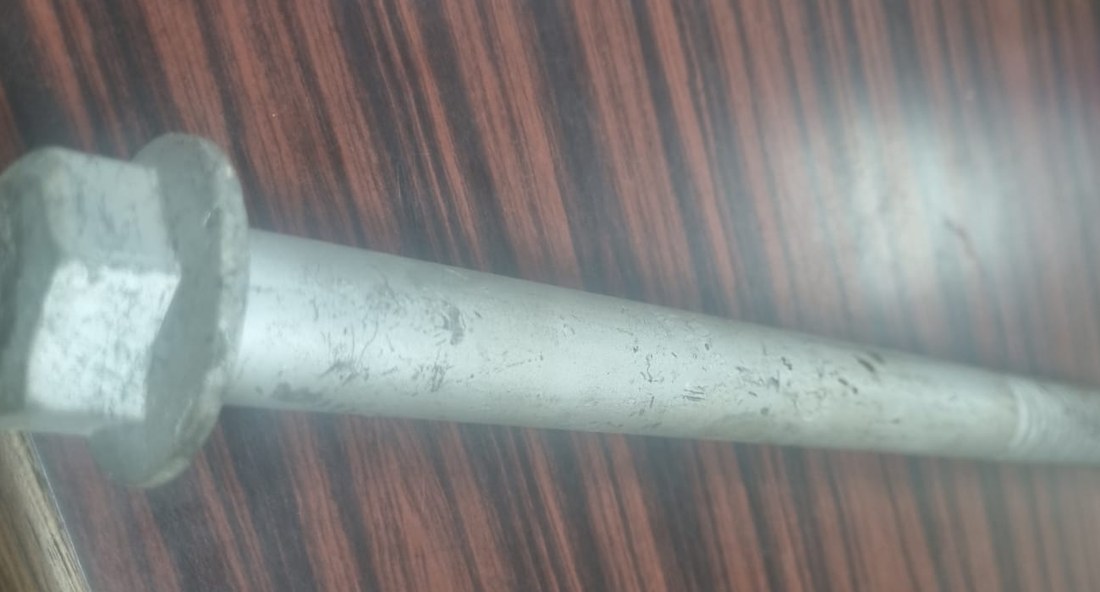
Straight bolts are the common case — a bolt through a pocket in one segment into a threaded socket or through-hole in the next.
Curved bolts are bent to an arc so the pocket in the segment can be shallower. A shallower pocket means less concrete removed, a stronger segment and less making good afterwards. They cost more and must match the segment geometry exactly.
Either way, the bolt is only half the joint. The other half is the cast-in socket or insert placed in the segment mould at the casting yard. Bolt and socket must match on thread form, pitch, diameter and engagement length. The single most common failure in this supply chain is a bolt ordered against the structural drawing while the socket was made to the mould supplier's own detail.
What a drawing needs to state
Tunnel segment bolts are not covered by one comprehensive product standard the way IS 3757 covers HSFG bolts. They are made to the project drawing. So the drawing has to carry everything:
- Diameter and length — length is set by the pocket depth, segment thickness and socket engagement, not chosen from a preferred series
- Thread form and pitch, stated explicitly — Tr or ACME, and the pitch
- Straight or curved, with the arc radius if curved
- Property class — commonly 8.8; lower classes appear where the bolt is purely temporary
- Coating — plain, hot-dip galvanised, or zinc flake for the permanent circumferential bolts in aggressive ground water
- Washer type and quantity per bolt
- The mating socket detail, or the socket supplier's part number
- Quantity per ring, and rings per delivery
That last point is commercial rather than technical, but it decides whether a supplier can actually serve the job. Segment bolt supply is a schedule problem: a TBM that stops because the bolts have not arrived is costing more per day than the whole bolt order is worth.
Where it goes wrong
Thread mismatch with the socket. Covered above, and the expensive one, because it is usually discovered at the tunnel face with the segments already cast.
Coating choking the thread. Hot-dip galvanising adds substantial thickness. On a coarse trapezoidal thread there is more room than on an ISO thread, but the socket must be tapped to suit, or the bolt binds. Decide the coating before the sockets are made, not after.
Wrong length for the gasket. Too short and the gasket never fully compresses, so the ring leaks. Too long and the bolt bottoms in the socket before the joint closes — which feels tight to the operator while the joint is still open.
Ordering to the wrong revision. Segment details change during a project. Bolts ordered against an old revision are scrap.
What S R Forgings supplies
We manufacture tunnel segment bolts to project drawings, including 5 mm pitch trapezoidal (ACME-form) threads, in straight and curved patterns, with matching nuts and washers — supplied with test certificates, plain, hot-dip galvanised or zinc flake coated.
Forging, heat treatment and threading are done in-house at our Focal Point, Ludhiana plant, which matters on this kind of work: segment bolt orders are large, repetitive and schedule-critical, and a supplier who is sub-contracting stages cannot hold a delivery programme through a full drive.
Send us the segment drawing and the socket detail, and we will confirm the pitch and profile against both before quoting.