Structural Bolts for Data Centre Construction
Data centre halls are built fast, in steel, at spans and column loads that push structural bolting to the top of its size range — and often past the sizes the standards tabulate.
Why data centre steelwork is different
Most data centres in India are built as pre-engineered steel buildings. The reasons are programme and load: a PEB hall goes up far faster than concrete, and the structure has to carry rack loads, heavy mechanical plant, chillers, generators and cable containment rather than just a roof.
For the bolting, that combination has three consequences. Connections are larger, because column loads are higher and spans are longer. The programme is tight, so a fastener that arrives late or wrong stops an erection crew that is being paid by the day. And because these are friction grip connections carrying real load, the bolt, nut and washer have to be a matched assembly tested together, not three items bought separately on price.
When the size goes past the standard
Structural bolting standards are written around the sizes used in ordinary building steelwork. On heavier data centre and industrial frames, designers call up diameters at and beyond the top of that range — and at that point there is often no grip length to look up and no head dimension to copy.
That is not a reason to refuse the size. It is a reason to engineer the part rather than look it up.
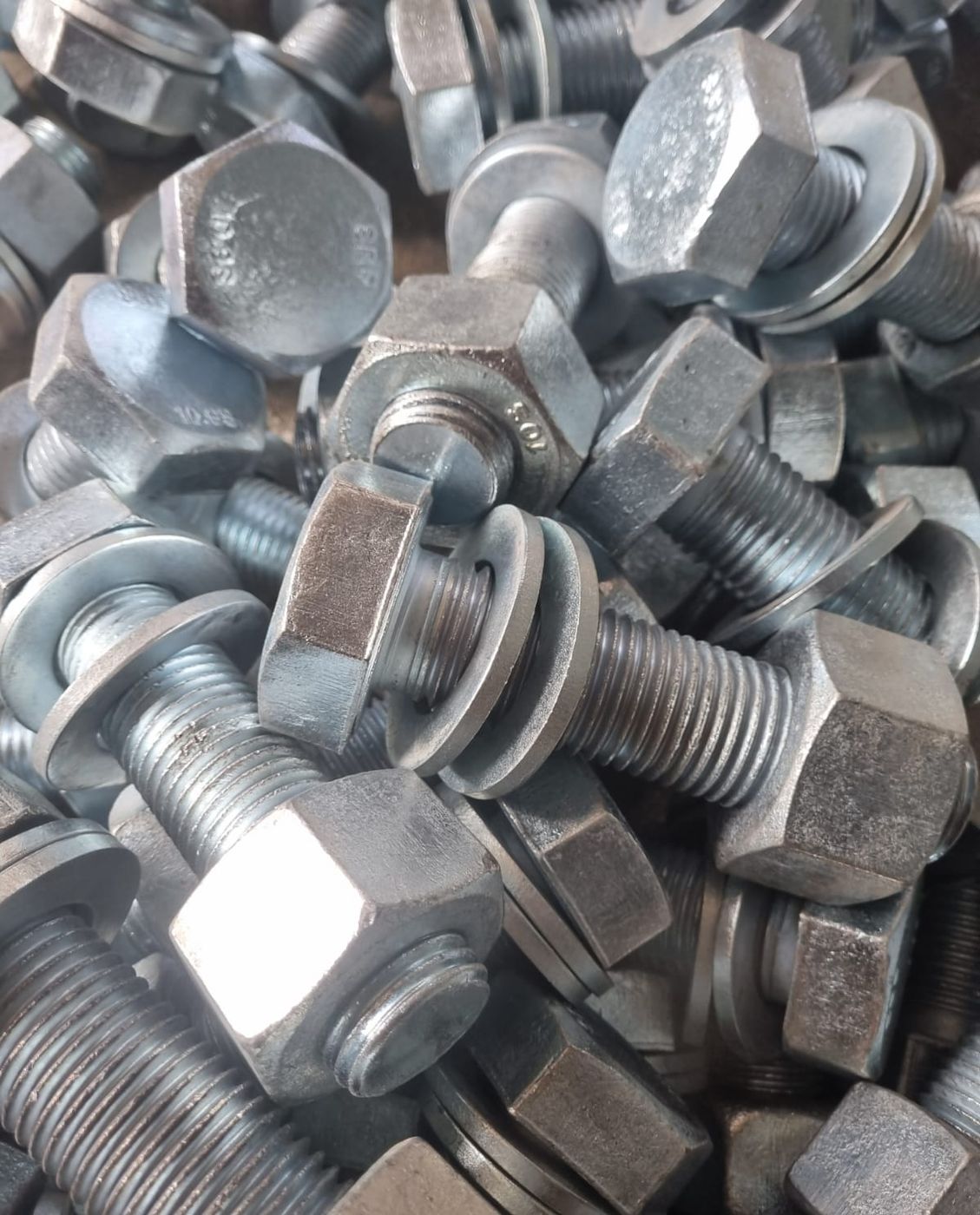
A recent example. Arwade Infrastructure Limited, a pre-engineered steel building and EPC contractor whose PEB work covers data centres, warehousing and industrial projects, came to us directly for M42 HSFG structural bolts for a data centre project. At that diameter there was no grip length available to work from. We manufactured the assemblies to a customised drawing with a heavy head — head dimensions taken from the next size up, 45 mm, on a 42 mm thread — so the bearing area under the head suited the connection rather than being scaled down from a smaller standard part. Supplied in property class 10.9S with matched nuts and washers.
The head is the part that gets overlooked. On a friction grip connection the head and nut bear directly on the plies, and if the head is undersized for the load the bearing stress goes where you do not want it. Taking head dimensions from a larger size is a straightforward answer, but it has to be stated on the drawing and agreed before manufacture, not discovered at site.
What to state on a data centre bolting enquiry
| Detail | Why it matters |
|---|---|
| Diameter and standard | IS 3757, EN 14399 or ASTM F3125 — they are not interchangeable, and grade markings differ |
| Grip length, or ply thicknesses | If the size is outside the tabulated range, give the plies and we will work the length |
| Head requirement | Standard or heavy head, and whether head dimensions are to be taken from a larger size |
| Assembly content | Nuts and washers per bolt, and whether the assembly is to be supplied matched |
| Finish | Black, hot dip galvanised or zinc flake — this changes the tightening torque, not just the appearance |
| Test requirement | Which tests, and whether third party or NABL-accredited reports are required |
Standards, and international data centre projects
Indian data centre steelwork is usually bolted to IS 3757, where a structural bolt is marked 10.9S. European projects call up EN 14399, and American ones ASTM F3125 with Grade A325 or A490. All three are preloaded friction grip systems doing the same structural job, but the grades, markings, testing and washer requirements differ, and the assembly must be consistent throughout.
We cover the differences in detail in our article on HSFG bolt standards, including when to specify black, hot dip galvanised or zinc flake coating.
What we supply for this sector
- HSFG structural bolt assemblies to IS 3757, in property class 8.8S and 10.9S, with matched nuts and washers
- Sizes above the tabulated range, made to customer drawing with engineered head and grip
- DTI washers to EN 14399-9 where tension indication is required
- Foundation and anchor bolts for column bases, generator and chiller plinths, up to 110 mm diameter
- Hot dip galvanised, black or zinc flake finish
- Test certificates per lot, with independent verification at a NABL-accredited laboratory
Have a drawing or a bolting schedule?
Send it across and we will quote against it, including sizes that fall outside the standard tables. More photographs of parts made here are in the product gallery, and dimension and weight tables are on our calculators and reference page.
Send your enquiry