HSFG Bolts Explained: IS 3757, EN 14399, ASTM F3125 (A325 / A490) — Differences, Applications and Coatings
First, what "HSFG" actually means
HSFG stands for High Strength Friction Grip. The term describes how the joint works, not how strong the bolt is.
In an ordinary bolted connection, load passes through the bolt in shear and through the plate in bearing. In a friction grip (slip-critical, preloaded) connection, the bolt is tightened to a defined preload — typically around 70% of its ultimate tensile capacity — and the load is carried by friction between the clamped plate faces. The bolt's job is to hold the plates together hard enough that they never slip.
That has one important consequence for buyers: an HSFG bolt is not a loose item. It is an assembly — bolt, nut and hardened washers — qualified together for preloading, and traceable to one manufacturer's certification. A grade 10.9 hex bolt bought off the shelf is a high tensile bolt; it is not automatically an HSFG bolt.
This is where most specification errors start. We have seen a project consultant order HSFG bolts and receive ASTM structural bolts, with everybody assuming they were the same thing. They are related, but they are not interchangeable.
IS 3757 — the Indian standard
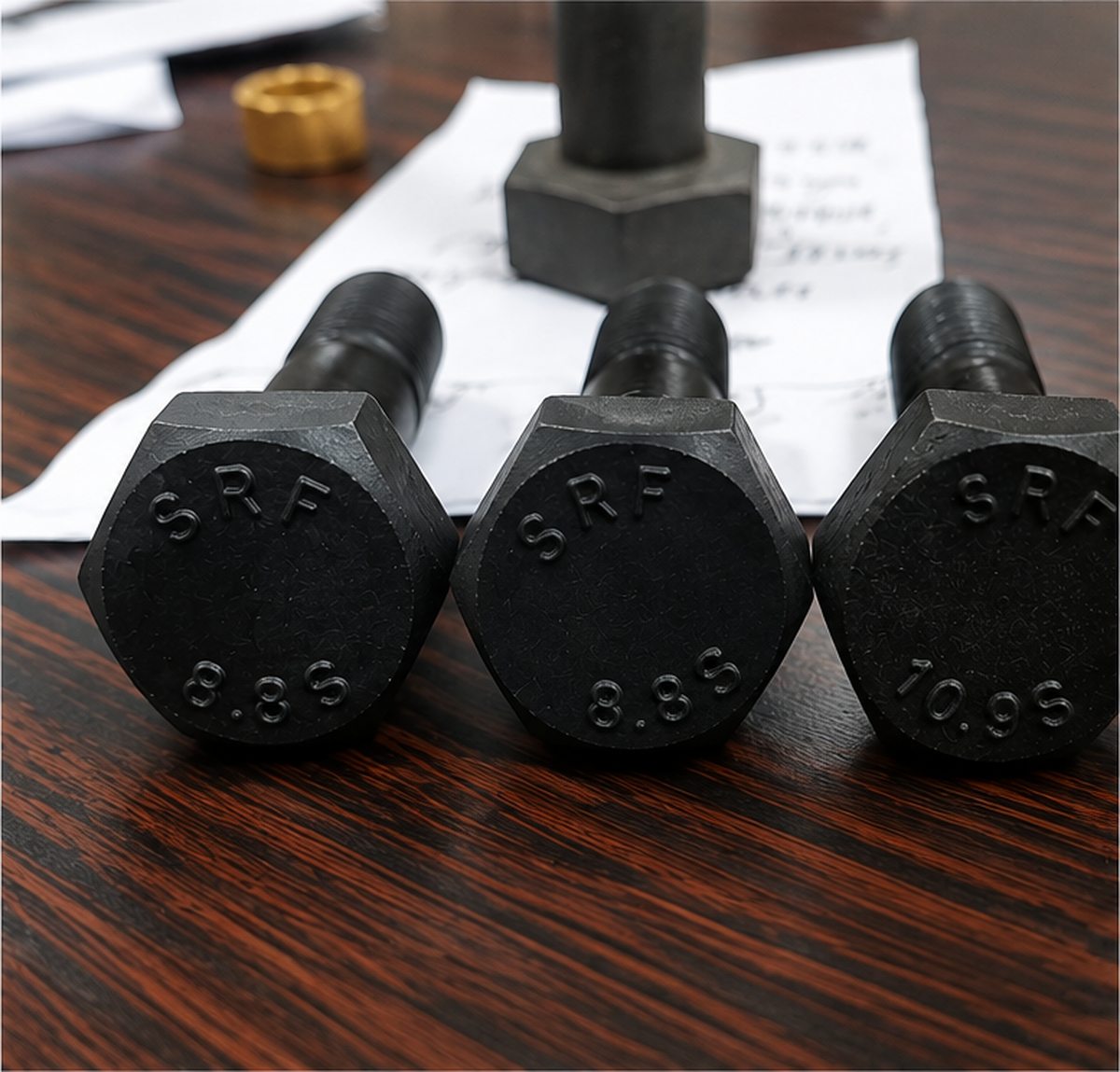
IS 3757:1985 covers high strength structural bolts in property classes 8.8S and 10.9S, sizes M16 to M36. The suffix "S" denotes a structural bolt with a large-series hexagon head — physically wider across flats than an ordinary IS 1364 / ISO 4014 hex bolt of the same diameter, so the head and nut bear properly on a hardened washer.
The bolt never stands alone. The Indian system is:
| Component | Standard |
|---|---|
| Bolt | IS 3757 — 8.8S / 10.9S |
| Nut | IS 6623 — property class 8S / 10S |
| Hardened and tempered washer | IS 6649 |
| Installation / code of practice | IS 4000 |
IS 4000 lists the preferred HSFG diameters as M16, M20, M24, M30 and M36. M18, M22 and M27 exist but are non-preferred sizes.
A typical designation reads: High Strength Structural Bolt M24 × 140 IS 3757 — 8.8S galvanized.
Where IS 3757 is used
Indian bridge work, railway structures, power plant steelwork, transmission and general building steel designed to Indian codes. Where a drawing says "HSFG bolts to IS 3757 with IS 6623 nuts and IS 6649 washers," this is the family to supply — with test certificates for the assembly, not for the bolt alone.
The practical limitation
IS 3757 tops out at M36 and is a short-thread (half-thread) product. The thread length was deliberately kept short so that no thread sits in the shear plane. That is correct engineering, but it assumes the designer knows the exact grip length and can call out the right bolt length.
On many current projects — data centres, large plant structures, heavy base plates — designers cannot fix that grip length early, and there is no IS 3757 option above M36. Those projects increasingly move to ASTM-pattern full-thread grade 10.9 bolting instead, which solves the same purpose without the grip-length arithmetic. We regularly supply M42 full-thread 10.9 sets for exactly this reason.
EN 14399 — the European system
EN 14399 is a ten-part series, and it is the most systematic of the three. It does not describe a bolt; it describes a bolting assembly qualified for preloading, tested as a set.
| Part | Content |
|---|---|
| EN 14399-1 | General requirements |
| EN 14399-2 | Suitability for preloading (the k-class tests) |
| EN 14399-3 | System HR — hexagon bolt and nut assemblies |
| EN 14399-4 | System HV — hexagon bolt and nut assemblies |
| EN 14399-5 | Plain washers |
| EN 14399-6 | Plain chamfered washers |
| EN 14399-7 | System HR — countersunk head assemblies |
| EN 14399-8 | System HV — hexagon fit bolt assemblies |
| EN 14399-9 | System HR or HV — direct tension indicators (DTI) |
| EN 14399-10 | System HRC — assemblies with calibrated preload (tension control) |
HR vs HV vs HRC — the real difference
- System HR (EN 14399-3): classes 8.8/8, 8.8/10 and 10.9/10, M12–M36. Tall nut (height about 0.9d) and a longer thread. Ductility comes from plastic elongation of the bolt — the bolt stretches before anything fails.
- System HV (EN 14399-4): class 10.9/10 only, M12–M36. Shorter nut (about 0.8d) and short thread. Ductility comes from plastic deformation of the engaged threads. This is the traditional German DIN 6914 pattern.
- System HRC (EN 14399-10): tension control bolts with a splined end that shears off at a calibrated preload — the European equivalent of the twist-off bolt.
Both HR and HV are designed to allow preloading of at least 0.7 × fub × As per Eurocode 3. Installation practice sits in EN 1090-2.
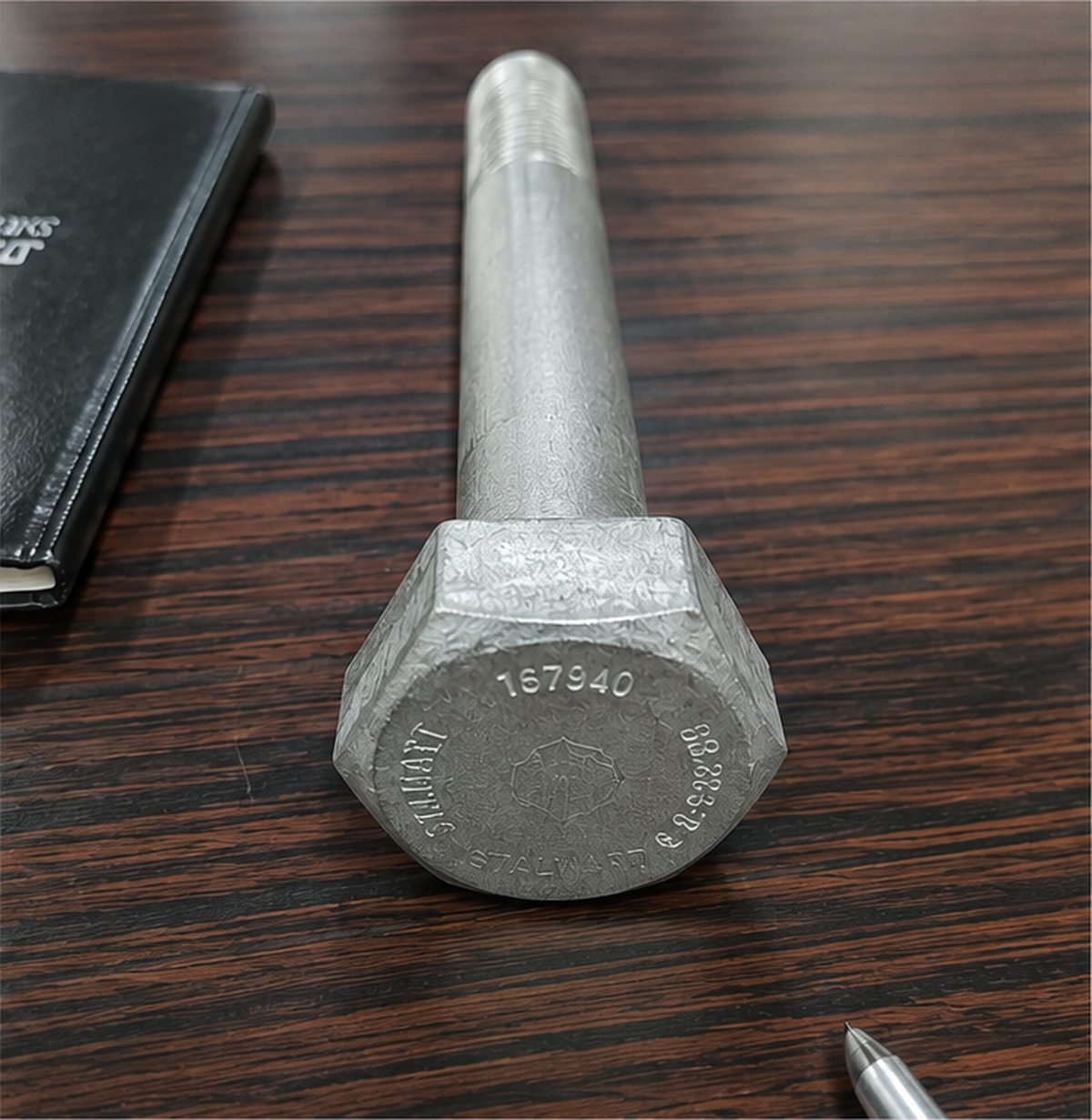
Two things buyers must respect with EN 14399: the assembly is supplied and marked as a set (HR8, HR10, HV10 on the bolt; matching marks on nut and washer), and the k-class friction condition is part of the certification. Mixing an HR bolt with an unqualified nut voids the preload behaviour the standard is built around.
Where EN 14399 is used
European steelwork, CE-marked structures under EN 1090, and increasingly Indian metro and infrastructure packages where the design consultant is European. EN 14399-9 DTI washers are also what RDSO calls for on Indian Railways work — which is the DTI standard we manufacture to.
ASTM F3125 — and why A325 and A490 are no longer standards of their own
This is the single most common point of confusion in enquiries we receive.
In 2016, ASTM A325 and A490 were withdrawn as standalone specifications and consolidated into ASTM F3125 / F3125M, an umbrella specification for high-strength structural bolts. A325 and A490 still exist — but as grades within F3125, not as standards. A correct modern specification reads "ASTM F3125 Grade A325", not "ASTM A325".
| Grade under F3125 | Steel | Tensile strength | Notes |
|---|---|---|---|
| A325 | Medium carbon | 120 ksi (½"–1"), 105 ksi (over 1" to 1½") | Heavy hex structural bolt |
| A490 | Alloy, quenched & tempered | 150 ksi min, 173 ksi max | Heavy hex structural bolt |
| A325M / A490M | Metric equivalents | Class 8.8 / 10.9 | Metric versions |
| F1852 | — | A325 strength level | Twist-off (tension control) type |
| F2280 | — | A490 strength level | Twist-off (tension control) type |
Types matter as well: Type 1 is ordinary carbon or alloy steel; Type 3 is weathering (atmospheric corrosion resistant) steel, used with weathering-steel members and normally supplied uncoated.
The matching components are A563 DH heavy hex nuts (A194 2H may substitute on Type 1) and F436 hardened washers. Installation and pretensioning follow the RCSC Specification: turn-of-nut, calibrated wrench, twist-off tension control, or direct tension indicator. Coated assemblies require rotational capacity testing as supplied — bolt, nut and washer together, from the same lot.
Where ASTM F3125 is used
US, Gulf and export projects; refineries and petrochemical structures; and a growing share of Indian private industrial work where the EPC contractor follows American practice.
Other standards worth knowing
- JIS B1186 — Japanese HSFG sets, grades F8T, F10T and S10T (S10T being the torshear/tension-control type). Common on Japanese-funded metro and bridge packages.
- BS 4395 — the old British HSFG standard (general grade / higher grade). Superseded by EN 14399 but still quoted on legacy drawings and refurbishment work.
- DIN 6914 / 6915 / 6916 — bolt, nut and washer of the older German HV system; effectively carried forward into EN 14399-4.
- GB/T 1228–1231 and GB/T 3632 — Chinese HSFG large hexagon and torshear sets, seen on Chinese-supplied plant.
- ASTM A354 Grade BD — not a structural bolt standard, but the correct call-out when A490-level strength is needed in a length or thread configuration that F3125 does not cover.
- IS 1367 / ISO 898-1 grade 10.9 hex bolts — high tensile, but not qualified for preloading unless specified and tested as such. Do not accept them against an HSFG line item.
Are they interchangeable?
No. They are corresponding standards, not equivalents. Head and nut dimensions, thread lengths, nut heights, washer hardness and — most importantly — the preload verification regime all differ. A substitution is an engineering decision that belongs to the design consultant, in writing, not a procurement convenience.
| IS 3757 | EN 14399-3 (HR) | EN 14399-4 (HV) | ASTM F3125 A325 / A490 | |
|---|---|---|---|---|
| Classes | 8.8S, 10.9S | 8.8/8, 8.8/10, 10.9/10 | 10.9/10 | 120/105 ksi, 150 ksi |
| Size range | M16–M36 | M12–M36 | M12–M36 | ½"–1½" |
| Thread length | Short | Longer | Short | Short (structural) |
| Nut height | Per IS 6623 | ≈ 0.9d | ≈ 0.8d | A563 DH heavy hex |
| Ductility from | Bolt | Bolt elongation | Thread deformation | Bolt |
| Install code | IS 4000 | EN 1090-2 | EN 1090-2 | RCSC |
Coatings: black, hot-dip galvanised or zinc flake
Coating on a preloaded bolt is never only about corrosion. It changes the friction under the nut, which changes the preload you get for a given torque or turn — and on the faying surfaces it changes the slip factor the whole connection depends on. This is why the coating must be declared at enquiry stage, not decided later.
1. Black / plain (self colour)
Uncoated, usually supplied lightly oiled. The cheapest option and the one with the most predictable, best-understood tightening behaviour.
Use it for: indoor and enclosed steelwork, connections that will be painted or fireproofed after erection, plant buildings in dry inland locations, short-duration temporary works. IS 3757 bolts in "dull black" finish remain the default on a great deal of Indian steelwork.
Watch for: no corrosion protection at all. Bolts must be stored dry and oiled, and exposed joints need site painting. Rust on a stored bolt also changes its friction — never tighten rusted, dried-out bolts to a torque figure derived from an oiled sample.
2. Hot-dip galvanised (HDG)
The workhorse for outdoor structural steel. For threaded fasteners the governing documents are EN ISO 10684 (spun galvanising for fasteners, M8–M64, property classes up to 10.9 for bolts) and ASTM F2329 / F2329M on the American side, with the base zinc process per ISO 1461.
Points that decide whether a galvanised HSFG job succeeds:
- Nuts must be tapped oversize after galvanising — tolerance class 6AZ or 6AX per ISO 965-5 — to clear the zinc on the bolt thread. An H or G nut on a galvanised bolt will seize.
- The oversize nut must be lubricated and, on ASTM work, the assembly must pass a rotational capacity test as a set. This is not paperwork; it is what proves the assembly can reach preload without stripping.
- Buy bolt, nut and washer galvanised together, from one source. Mixing a galvanised nut with a differently coated bolt is prohibited under F3125 and is bad practice everywhere else.
- Grade 10.9 / A490 caution. ISO 10684 stops at property class 10.9 and requires care in processing; under ASTM F3125, hot-dip galvanising, mechanical deposition and zinc electroplating are prohibited outright on Grade A490 because of hydrogen embrittlement risk at the 150 ksi strength level. A galvanised A490 bolt is a non-conforming bolt, however good it looks.
- Faying surfaces: a galvanised contact surface has a lower slip factor than blast-cleaned bare steel. Under RCSC practice, hot-dip galvanised faying surfaces are treated as Class A (µ ≈ 0.30) and normally require hand wire-brushing after galvanising; blast-cleaned bare steel reaches Class B (µ ≈ 0.50). EN 1090-2 uses slip factor classes A (0.5) through D (0.2), with testing required for surfaces not covered by the standard cases. The designer must know which one is being supplied.
Use it for: bridges, flyovers, transmission towers, outdoor plant, coastal and industrial atmospheres, anything with a long design life and no realistic access for repainting. Typical zinc thickness for spun-galvanised fasteners gives service life measured in decades in inland conditions.
3. Zinc flake (Dacromet / Geomet / Magni type systems)
A thin, non-electrolytic coating of zinc and aluminium flakes in an inorganic binder, applied by dip-spin or spray and oven cured. Governed by EN ISO 10683 in Europe and by ASTM F1136 Grade 3, F2833 Grade 1 and F3019 in the US (now consolidated under ASTM F3393).
Why it matters for high strength bolting:
- No hydrogen embrittlement risk. There is no acid pickling and no electrolytic bath, and cure temperatures stay well below tempering temperature. This is why zinc flake is the only coating family ASTM permits on Grade A490 — F1136 Grade 3 or F2833 Grade 1.
- Thin and dimensionally friendly. Typically 8–20 µm against roughly 45–85 µm for HDG, so threads are not choked and nuts need no dramatic oversizing.
- Controlled coefficient of friction. EN ISO 10683 lets you specify a friction band (for example µ = 0.10–0.20), which is a real advantage where preload is set by torque.
- Excellent salt-spray performance for its thickness — commonly specified at 240, 480 or 720 hours and higher with topcoats.
- Component grades differ. Standard practice is Grade 3 on bolts and washers and a lubricated Grade 5 on nuts. Do not mix coating systems within one assembly.
Limitations to respect: zinc flake is thinner and less mechanically robust than HDG — it does not tolerate heavy abrasion, dragging on site, or hard impact as well. It is also a licensed process with a higher unit cost. It is not a like-for-like substitute for hot-dip galvanising in a high-abrasion environment; it is a substitute where embrittlement, thread clearance or friction control matters more than coating thickness.
Use it for: grade 10.9 and A490 assemblies in corrosive service, offshore and coastal structures, projects where torque-controlled tightening must be repeatable, and applications where a galvanised thread simply will not fit.
What about zinc electroplating and phosphating?
Electroplated zinc is fine on lower-grade fasteners but carries a hydrogen embrittlement risk on 10.9 and above unless baking is properly controlled — and it is expressly prohibited on A490. It is not a marine-grade coating in any case. Phosphate and oil (IS 1367 Part 12) is a storage and running-in finish, not corrosion protection for exposed steelwork.
Quick selection guide
| Environment / requirement | Sensible choice |
|---|---|
| Indoor, enclosed, or painted after erection | Black / plain, oiled |
| Outdoor onshore structure, long life, 8.8 or 10.9 | Hot-dip galvanised to ISO 10684 / F2329 |
| Coastal, marine or heavy industrial atmosphere | HDG (heavier duty) or zinc flake with topcoat |
| Grade A490 or any 150 ksi class bolt needing protection | Zinc flake only (F1136 Gr 3 / F2833 Gr 1) |
| Torque-controlled tightening, tight friction window | Zinc flake to EN ISO 10683 with declared µ |
| Weathering steel (Type 3) members | Uncoated Type 3 assemblies |
Five mistakes we see most often
- Treating a 10.9 hex bolt as an HSFG bolt. Different head series, different nut, no preload qualification.
- Writing "ASTM A325" on a 2026 drawing. The correct call-out is ASTM F3125 Grade A325.
- Galvanising A490. Prohibited, and the failure mode is delayed and brittle.
- Mixing sources within one assembly. Bolt from one maker, nut from another, washer from a third — the preload behaviour is then nobody's guarantee.
- Reusing preloaded bolts. Once a bolt has been taken to preload it has yielded by design. Black bolts may sometimes be reused with engineering approval; galvanised assemblies should not be.
What S R Forgings supplies
We manufacture HSFG bolting to IS 3757 with IS 6623 nuts and IS 6649 hardened washers, to EN 14399-3, and to ASTM F3125 Grade A325 / A490 pattern — supplied as complete sets with nuts and washers, and with test certificates covering the assembly. We also manufacture direct tension indicator washers to EN 14399-9, the standard called for by RDSO.
Sizes run well beyond the IS 3757 ceiling, including M42 full-thread grade 10.9 sets for projects where the short-thread IS pattern does not suit the grip. Bolts are supplied black, hot-dip galvanised, or zinc flake coated to the standard your specification names.
Forging, heat treatment and rolled threading are done in-house at our Focal Point, Ludhiana plant, with rolled (no-cut) threads available up to Ø100 mm.
If you have a drawing, a coating specification, or simply a doubt about which standard your project should be quoting, send it across and we will come back with a technical recommendation and a price. → Send an enquiry
Standards referenced: IS 3757:1985, IS 6623, IS 6649, IS 4000, IS 1367; EN 14399 Parts 1–10, EN 1090-2, EN ISO 898-1/2, EN ISO 10684, EN ISO 10683, ISO 1461, ISO 965-5; ASTM F3125/F3125M, A563, F436, F2329, F1136, F2833, F3019, F3393, A354; RCSC Specification for Structural Joints. Always work from the current edition of the governing standard for your project.