Why HSFG Bolts Replaced Rivets in Bridges
For roughly a century, if you built a steel bridge, you riveted it. Then, over about twenty-five years in the middle of the twentieth century, riveting disappeared from new construction almost entirely. Understanding why is worth more than a history lesson, because the reasoning explains what a modern preloaded bolt is actually for — and because engineers in India still meet rivets regularly, on structures that are now eighty and a hundred years old and need repair.
A riveted joint and a preloaded bolt do the same thing
This is the part that gets missed. Rivets and HSFG bolts are not opposites. They are two ways of reaching the same result.
A rivet goes into the hole red hot, at something like 1000 °C, and is hammered until it fills the hole and forms a second head. Then it cools. As it cools it contracts along its length, and because the two heads are bearing against the outer plates, that contraction pulls the plates hard together. A finished rivet is a bolt in permanent tension, and the joint it makes carries load largely by friction between the clamped plates.
That is exactly what a High Strength Friction Grip bolt does. It is tightened to a defined preload, typically around 70% of its ultimate capacity, and the load passes through friction between the faying surfaces rather than through the bolt in shear.
So the modern preloaded bolt is not the rivet's opposite. It is its descendant — the same clamping principle, with the clamping force made deliberate, calculable and measurable instead of being a by-product of thermal contraction.
What riveting was actually good at
Riveting held its position for a century because it genuinely worked, and it is worth being fair about that.
It filled the hole. A driven rivet expands to fill the hole completely, so there is no slip at all before bearing. A bolt in a clearance hole does not do this unless it is preloaded or fitted.
It could not loosen. There is no thread to back off, no nut to lose, and nothing for vibration to work on. On a railway bridge carrying a century of live load, that mattered.
It was made from ductile material. Rivet steel was soft and tough. Riveted joints deform and complain before they fail, which is a good property in a structure nobody is monitoring.
It suited the material available. Wrought iron and early mild steel were not consistent enough for high strength bolting. Riveting worked with what could actually be made in 1880.
And it is repairable in kind. On a heritage structure, a rivet can be cut out and replaced with a rivet, which matters when the bridge is protected and its appearance is part of what is being conserved.
Why it lost anyway
The reasons are practical rather than structural, and they compound.
Labour. A riveting gang was four men: one heating rivets in a portable forge, one catching and placing, and two on the hammer, one holding up the head. All of them skilled, all of them needed simultaneously, and none of them cheap. An HSFG connection takes two people and a wrench.
Speed and cost. A gang got through a limited number of rivets in a shift, and every one needed the forge lit and the coke supplied. Bolting is faster by a wide margin and needs no heat at all.
Site safety. Open forges, red hot steel being thrown and caught, sustained noise that ruined hearing, and hot work over water or a live railway. Every one of those became a serious problem as safety expectations rose. Fire risk alone ruled out riveting on many sites.
Quality was unverifiable. This is the decisive one. A riveted joint's clamping force depends on how hot the rivet was, how well it was driven, and how it cooled. None of that can be checked afterwards. A rivet that looks sound may be loose inside the hole, and tapping it with a hammer to listen for the ring is not a measurement.
A preloaded bolt can be verified. Turn-of-nut, calibrated wrench, tension control bolts, or a direct tension indicator washer that shows the installed preload by how far its protrusions have flattened. The result is a connection whose clamping force is a specified, checkable quantity rather than an act of faith.
And the material caught up. By the 1930s and 40s, heat treated alloy steel could be made consistently enough to hold high preload, and research work on bolted joints — leading to the formation of the Research Council on Riveted and Bolted Structural Joints in 1947 and its first specification in 1951 — established that preloaded bolted connections performed at least as well as riveted ones under fatigue.
Once that was proved, riveting had no argument left. Through the 1950s and 60s it fell away, and by the 1970s new riveted bridgework had effectively ended.
Side by side
| Riveted connection | HSFG bolted connection | |
|---|---|---|
| Load path | Friction, from cooling contraction | Friction, from applied preload |
| Clamping force | Uncontrolled, varies rivet to rivet | Specified and verifiable |
| Inspection | Visual and acoustic only | Turn-of-nut, torque, TC bolt or DTI |
| Hole filling | Complete | Clearance, unless fitted bolts used |
| Labour | Four-man gang, skilled | Two people |
| Heat on site | Forge required | None |
| Noise | Severe | Ordinary |
| Removal | Cut or burn out, destructive | Unbolt |
| Fatigue performance | Good | Equal or better |
| Loosening risk | None | Requires correct installation |
Where rivets still appear
Not in new construction. But India has a very large stock of riveted railway and road bridges from the late nineteenth and early twentieth century, and those structures still need work. When they do, three questions come up repeatedly.
Can a rivet be replaced with a bolt? Usually yes, and it is the normal repair. But it is not automatic. The rivet filled its hole; the replacement bolt will not, unless it is a fitted bolt or the connection is designed as slip-critical so that it does not need to. The hole is also likely to be irregular after a century, and may need reaming to a larger size, which changes the bolt required.
Which bolt? For a slip-critical replacement in India, an IS 3757 assembly with IS 6623 nuts and IS 6649 washers is the normal answer. Where the connection is checked as bearing type, an ordinary high tensile bolt may serve — but that is the designer's call, not the contractor's.
What about the faying surfaces? A hundred-year-old joint has paint, rust and mill scale between the plates. The slip factor the designer assumes depends entirely on what those surfaces are like when the bolt is tightened. This is where rehabilitation work most often goes wrong.
And on protected heritage structures, rivets are sometimes replaced with rivets, or with bolts made to look like them, because the appearance of the structure is part of what is being preserved.
What it means for specifying today
The useful lesson from all this is that a preloaded connection only works if the preload is actually achieved. The rivet gang's problem — no way to know whether the clamping force was there — did not disappear when bolts arrived. It just became solvable.
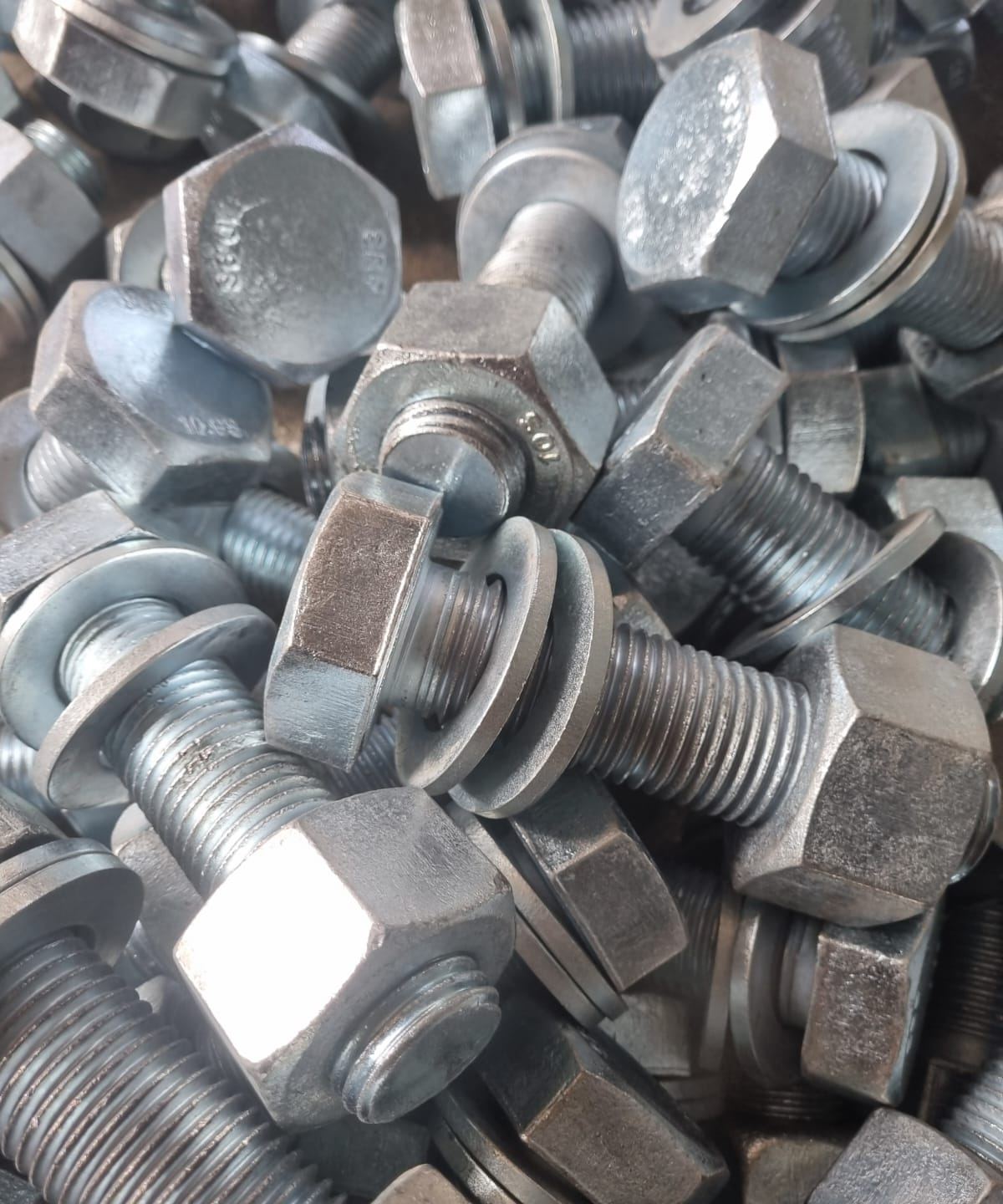
Which is why an HSFG bolt is never a loose item. It is an assembly of bolt, nut and hardened washers, certified together, installed by a defined method, and verified. A grade 10.9 hex bolt bought by the kilo is a high tensile bolt. It is not an HSFG connection.
S R Forgings manufactures HSFG bolting assemblies to IS 3757 with IS 6623 nuts and IS 6649 hardened washers, to EN 14399-3, and to ASTM F3125 Grade A325 and A490 pattern, supplied as complete sets with test certificates. We also manufacture direct tension indicator washers to EN 14399-9, the standard called for by RDSO on Indian Railways work — the simplest way to prove on site that the preload a rehabilitation design depends on has actually been reached.
If you are working on a bridge rehabilitation and need bolting to match an existing riveted connection, send us the drawing and the hole sizes.