Why Oil and Gas Uses B7 and B7M Instead of 8.8, 10.9 or Stainless
Walk any refinery, any wellhead, any gas processing plant, and the studs holding the flanges together will be ASTM A193 Grade B7. Not property class 8.8. Not 10.9. Not stainless. The same grade, everywhere, for decades.
The usual explanation is that B7 is stronger. It isn't. Understanding what it actually is explains a great deal about how pressure equipment is specified.
B7 is weaker than 10.9
Start with the numbers, because they kill the common assumption immediately.
| Tensile strength | Yield | Elongation | |
|---|---|---|---|
| Class 8.8 | 800 MPa | 640 MPa | 12% |
| A193 B7 (to 2½") | 860 MPa | 725 MPa | 16% |
| Class 10.9 | 1040 MPa | 940 MPa | 9% |
| Class 12.9 | 1220 MPa | 1100 MPa | 8% |
B7 sits between 8.8 and 10.9. A 10.9 bolt is roughly 20% stronger.
So strength was never the reason. Look instead at the last column.
Ductility is the point
B7 requires 16% elongation and 50% reduction of area. Class 10.9 requires 9%. Class 12.9 requires 8%. B7 is twice as ductile as 12.9 and half again more than 8.8.
On a pressure-containing flange, that difference decides how the joint behaves when something goes wrong.
A ductile bolt under excessive load stretches. It yields visibly and progressively, the flange loses clamping force, the gasket weeps, and someone notices a leak. That is a maintenance problem — expensive, but survivable, and it announces itself.
A high-strength, low-ductility bolt does not do this. At 8 or 9% elongation the material is notch sensitive: a thread root, a small corrosion pit or a minor tool mark becomes a crack initiation site, and the bolt fails suddenly and completely. On a flange carrying hydrocarbons at pressure, several bolts failing without warning is not a maintenance problem.
This is the same reasoning that runs through pressure vessel design generally: a system that leaks before it breaks can be caught. One that breaks without leaking cannot.
There is also a practical use for that ductility. Large B7 studs are tightened with hydraulic tensioners, and the fitter sets preload by measuring how much the stud has actually stretched. The elongation is not just a safety margin — it is the working mechanism used to control bolt load.
The tempering temperature tells the same story
ASTM A193 sets a minimum tempering temperature of 593 °C for B7. ISO 898-1 requires 425 °C for property classes 8.8 and 10.9.
B7 is the same steel family as a metric 10.9 bolt — chromium-molybdenum, essentially 4140 or 4142. The difference is that B7 is deliberately tempered far harder, giving up strength to buy ductility, toughness and stability at temperature.
A 10.9 bolt is optimised for maximum strength at room temperature. A B7 stud is optimised to hold a known load, predictably, for years, hot.
What the code actually allows
There is a more basic reason an engineer cannot specify 10.9 on a refinery flange even if they wanted to: it is not in the code.
A flanged joint on a pressure system is designed to ASME rules, and those rules need allowable stress values for the bolting material at the design temperature. Those values are published for A193 grades. Property classes 8.8, 10.9 and 12.9 are room-temperature strength specifications with no allowable stress tables at elevated temperature. They do not appear in the pressure design codes, so they cannot be used in a design calculation.
Temperature is the reason. A metric property class bolt is tested at room temperature and the standard says nothing about what it retains at 300 °C after two years of thermal cycling. B7 is characterised at temperature, which is what a flange actually needs.
Above B7's range, the same logic continues upward — Grade B16, a chromium-molybdenum-vanadium steel, takes over for higher temperature service.
Sour service: why B7M exists
Where the process stream contains hydrogen sulphide, everything changes. H₂S drives sulphide stress cracking, and susceptibility rises sharply with hardness.
NACE MR0175 / ISO 15156 caps low-alloy steel bolting at 22 HRC, equivalent to 235 HBW.
Standard B7 is permitted up to 35 HRC, so it is not acceptable. Grade B7M is the answer: identical chromium-molybdenum chemistry, tempered further to hold hardness below the ceiling.
What B7M gives up and gains:
| B7 | B7M | |
|---|---|---|
| Tensile strength, min | 125 ksi | 100 ksi |
| Yield, min | 105 ksi | 80 ksi |
| Elongation, min | 16% | 18% |
| Hardness, max | 321 HBW / 35 HRC | 235 HBW / 22 HRC |
| Hardness testing | Sampling | 100% of pieces |
Note the direction. B7M is weaker again, and more ductile again. The trade-off runs consistently one way throughout this whole subject: as the service gets more critical, the industry moves toward softer, tougher bolting, not harder and stronger.
Two things follow that buyers should hold on to. B7M requires 100% hardness testing — every single piece, not a sample from the lot — because one over-hard stud in a sour joint is enough. And B7M must be paired with A194 Grade 2HM nuts, held to the same 22 HRC ceiling. A B7M stud with a standard 2H nut is not a compliant assembly.
Against this, property class 10.9 sits around 32 to 39 HRC and 12.9 higher still. Both are structurally excluded from sour service by hardness alone. Grade 12.9 has no place in oil and gas at all — notch sensitive, prone to hydrogen embrittlement, and never permitted where cracking risk exists.
Why not stainless steel
Stainless looks like the obvious upgrade for a corrosive environment. It is used in oil and gas, but selectively, and for good reasons.
It is much weaker. A193 Grade B8 Class 1, solution annealed, has a yield strength around 205 MPa — roughly a quarter of B7. Replacing B7 with B8 Class 1 at equal load means substantially larger bolts, larger flanges and a redesigned joint.
Chloride stress corrosion cracking. Austenitic stainless in warm chloride-bearing environments — which describes most offshore and coastal installations — is vulnerable to a cracking mechanism carbon steel does not suffer.
Galling. Stainless threads seize against stainless threads under load. On a flange that will be opened for maintenance, this is a real operational cost.
Thermal expansion mismatch. Austenitic stainless expands roughly 50% more than the carbon steel flange it clamps. Every heating and cooling cycle changes the bolt load, and joints lose preload over time.
Where stainless does earn its place: highly corrosive process streams, cryogenic service, and applications where the external environment attacks carbon steel faster than the coating can protect it. For sour service, B8 and B8M Class 1 in the solution-annealed condition are accepted under the same 22 HRC ceiling.
Low temperature: A320 L7
One more grade completes the picture. Below about −29 °C, carbon and low-alloy steels lose toughness, and a bolt that was ductile at ambient can behave brittly in the cold.
ASTM A320 Grade L7 is essentially the same 4140 chemistry as B7 with mandatory Charpy impact testing at low temperature. For cold service that is also sour, L7M applies both the impact requirement and the 22 HRC hardness ceiling, paired with A194 Grade 7M nuts.
The selection in one table
| Service | Stud | Nut |
|---|---|---|
| General high pressure and temperature | A193 B7 | A194 2H |
| Sour service, H₂S present | A193 B7M | A194 2HM |
| Low temperature | A320 L7 | A194 7 |
| Low temperature and sour | A320 L7M | A194 7M |
| Higher temperature | A193 B16 | A194 4 or 7 |
| Corrosive process, cryogenic | A193 B8 / B8M | A194 8 / 8M |
Property classes 8.8, 10.9 and 12.9 do not appear anywhere in that table, and that is the whole answer to the question.
What this means when you order
If you buy bolting for process plant, three things are worth checking on every order:
The nut must match the stud. B7M with 2H is not compliant. This is the most common error in sour service bolting and it is entirely a procurement mistake, not a manufacturing one.
Ask for the tempering temperature. It should be on the certificate. For B7 it should be at or above 593 °C. A manufacturer who cannot tell you has told you something.
For B7M, ask whether hardness testing was 100% or by sample. The standard requires every piece. Some certificates say "sample tested" in the closing paragraph while claiming B7M in the header. Those two statements contradict each other.
What we supply
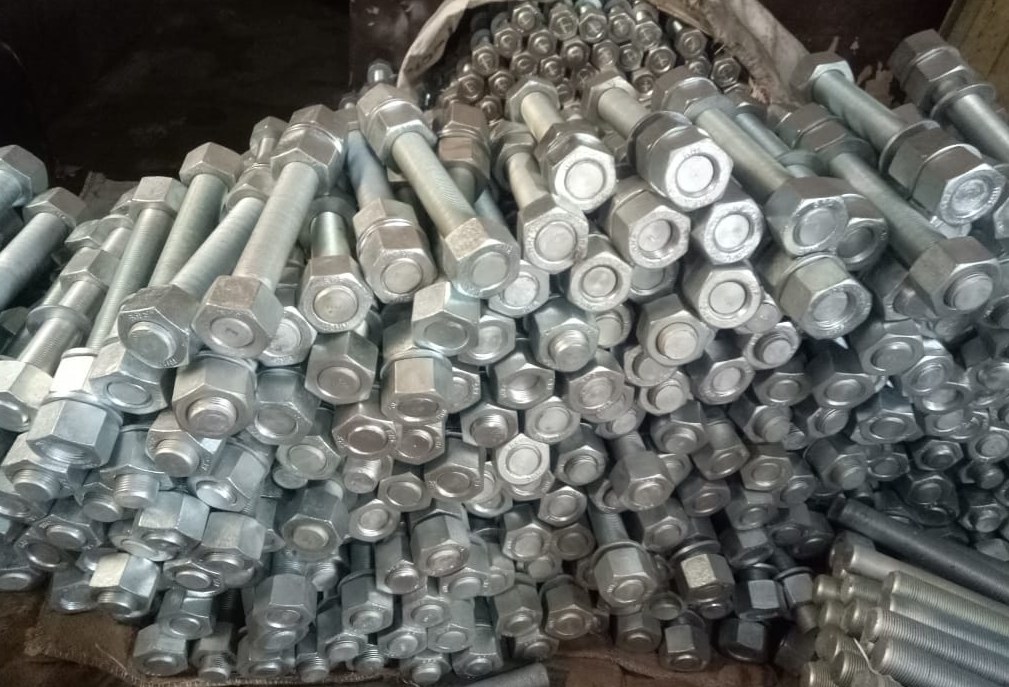
S R Forgings manufactures ASTM A193 B7 and B7M stud bolts and threaded bars, with matching A194 2H and 2HM heavy hex nuts and washers, supplied as complete assemblies with test certificates.
A recent export order gives a sense of the work: 972 sets of 1-7/8" × 15-1/8" B7M studs with 2HM nuts and washers, supplied through an Indian export house for a refinery in Kuwait. Oil quenched at 880 °C and tempered at 620 °C, giving 21 HRC against the 22 maximum, with 18.5% elongation and 60% reduction of area against requirements of 18% and 50%. Chemistry mid-band on every element.
Forging, heat treatment and threading are done in-house at our Focal Point, Ludhiana plant, and material testing is carried out at a NABL accredited laboratory.
If you have a bolting specification for process plant — or a certificate you would like read properly — send it across.