More engineers are specifying M39, M42 and M48 structural bolts than used to. Data centre structures, heavy pre-engineered buildings, transfer girders and large base plates all push connection loads past what an M36 bolt group carries economically.
Then the drawing reaches a fabricator, and the questions start — because every structural bolting standard in the world stops at M36. These are the questions we are actually asked. The answers are what S R Forgings manufactures, and why.
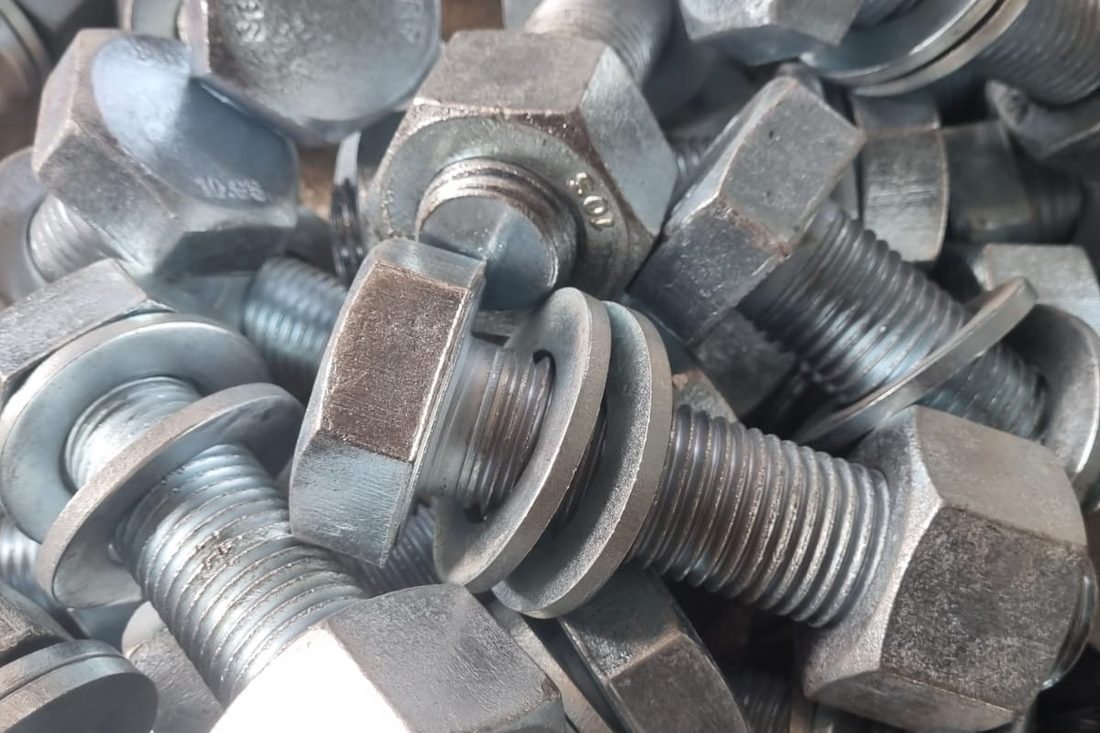
M36 bolt dimensions: standard hex bolt or structural bolt?
M36 is the last size that every structural bolting standard covers, and most engineers start there before going larger. The first thing to settle is which M36 you mean, because two bolts sold as “M36” have different heads, different thread lengths and different washers.
| M36 | Standard hex bolt (ISO 4014) | HSFG structural bolt (IS 3757) |
|---|---|---|
| Thread | M36 × 4.0 coarse | M36 × 4.0 coarse |
| Width across flats | 55 | 60 |
| Head height, nominal | 22.5 | 22.5 |
| Thread length | 84 (bolts up to 125 long) | 56 (bolts up to 100 long), 63 (over 100) |
| Stress area | 817 mm² | 817 mm² |
| Proof load, 8.8 / 8.8S | 490,200 N | 490,200 N |
| Proof load, 10.9 / 10.9S | 678,110 N | 678,110 N |
| Preload, 10.9S (0.7 × 1000 MPa × As) | — | about 572,000 N |
| Nut and washer | ISO 4032 nut, plain washer | IS 6623 heavy nut, IS 6649 hardened washer |
The thread and the stress area are the same, so on paper the two bolts carry the same load. They are not interchangeable. The structural head is 5 mm larger across flats so that it can spread preload into the ply, and its thread is 28 mm shorter so that the plain shank stays in the shear plane. A standard M36 hex bolt delivered for a friction-grip joint has the wrong head, the wrong thread length and no hardened washer.
Above M36 the standards stop but the same rules carry on. That is what the rest of this page sets out.
Why do HSFG bolt standards stop at M36?
IS 3757 stops at M36. EN 14399 stops at M36. ASME B18.2.3.6M stops at M36. ISO 898-1, which defines property classes 8.8 and 10.9, stops at M39. Two reasons, and both still apply today.
Through-hardening becomes unreliable. To call a bolt 10.9 you need 1040 MPa tensile through the core, not just at the surface. As the section grows, the quench cannot pull heat out of the centre fast enough, and ordinary carbon-alloy steel stops hardening all the way through. Hardenability is a property of the steel, and every alloy has a section size beyond which it will not harden through. Reaching further up the size range means moving to a richer alloy, and eventually there is no ordinary bolting steel left to move to. That boundary is where we change material in the shop — EN18 for 8.8 across the range, EN18 for 10.9 only up to 27 mm, and 4140 above that.
Preload cannot be verified by ordinary site methods. HSFG is a preload system, not a strength system. The whole design depends on reliably achieving and confirming clamping force, and the part-turn tables that make that possible were established experimentally, size by size, up to M36 and no further. An M48 bolt at 10.9 is preloaded to about 1,030,000 N — seventy per cent of its tensile capacity. You do not reach that with an impact wrench and a half-turn rule — you reach it with hydraulic tensioning. The standard is silent above M36 because the installation method it assumes stops working there.
Neither problem is unsolvable. Both have to be solved deliberately, on each job, by the manufacturer — which is why there is no catalogue for it.
Can I just use a standard hex bolt at M39 instead?
This is the most expensive mistake on this page, so it is worth being blunt.
A standard ISO 4014 hex head at M39 has a width across flats of 60 mm. An IS 3757 structural bolt at M36 also has a width across flats of 60 mm.
Upgrade a connection from M36 structural to M39 to gain capacity, take delivery of a standard hex bolt, and you have a larger thread with no increase whatsoever in bearing area under the head. On a preloaded connection the head has to distribute a very large clamping force into the ply without crushing it. You have gained thread area and gained nothing where it matters.
The structural head has to be made larger deliberately. It does not happen by itself.
What head will I actually get?
Two different rules govern the two head dimensions, and mixing them up is the commonest error. Width across flats takes the ISO 4014 figure for the next size up. Head height stays at the bolt's own nominal size, with the tolerance band widened. Both rules are read directly off the IS 3757 table, where they hold at every one of its seven sizes, and we continue them above M36.
Tell a fabricator “use the M45 head on the M42 bolt” and he will apply it to both dimensions, giving a head that is too tall — and grip and wrench clearance will both be wrong.
| Size | Pitch | Width across flats | Across corners min | Head height | Shank diameter | |||
|---|---|---|---|---|---|---|---|---|
| min | max | min | max | min | max | |||
| M39 | 4.0 | 63.10 | 65.00 | 71.30 | 23.95 | 26.05 | 38.00 | 40.00 |
| M42 | 4.5 | 68.10 | 70.00 | 76.95 | 24.95 | 27.05 | 41.00 | 43.00 |
| M45 | 4.5 | 73.10 | 75.00 | 82.60 | 26.95 | 29.05 | 44.00 | 46.00 |
| M48 | 5.0 | 78.10 | 80.00 | 88.25 | 28.95 | 31.05 | 47.00 | 49.00 |
| M52 | 5.0 | 82.80 | 85.00 | 93.55 | 31.75 | 34.25 | 50.80 | 53.20 |
| M56 | 5.5 | 87.80 | 90.00 | 99.20 | 33.75 | 36.25 | 54.80 | 57.20 |
| M60 | 5.5 | 92.80 | 95.00 | 104.85 | 36.75 | 39.25 | 58.80 | 61.20 |
Intermediate and larger sizes to customer drawing. We have manufactured customised HSFG bolts up to 75 mm diameter — see our HSFG and high tensile bolt range and our data centre structural bolts.
How long is the thread?
Short, and deliberately so. The plain shank has to reach into the grip so the threads stay clear of the shear plane. Too long and threads sit in shear; too short and the nut runs out before it seats.
IS 3757 follows a pitch-based rule, not a diameter-based one — because thread length has to cover nut height, washer thickness and run-out, and all three scale with pitch:
b = d + 2P + 11 for M16 to M27, and b = d + 2P + 12 for M30 and above. That reproduces every thread length in the IS 3757 table exactly. We continue it.
| Size | Pitch | Thread length, bolt ≤ 100 | Thread length, bolt > 100 |
|---|---|---|---|
| M36 (IS 3757) | 4.0 | 56 | 63 |
| M39 | 4.0 | 59 | 66 |
| M42 | 4.5 | 63 | 70 |
| M45 | 4.5 | 66 | 73 |
| M48 | 5.0 | 70 | 77 |
| M52 | 5.0 | 74 | 81 |
| M56 | 5.5 | 79 | 86 |
| M60 | 5.5 | 83 | 90 |
My European drawing shows a different thread length. Who is right?
Both — and this is the single most common cause of a rejection at site. EN 14399 contains two systems with completely different thread lengths, and they are not interchangeable.
| Size | EN 14399-3 (System HR) | IS 3757 | EN 14399-4 (System HV) |
|---|---|---|---|
| M16 | 38 | 31 | 28 |
| M20 | 46 | 36 | 33 |
| M22 | 50 | 38 | 34 |
| M24 | 54 | 41 | 39 |
| M27 | 60 | 44 | 41 |
| M30 | 66 | 49 | 44 |
| M36 | 78 | 56 | 52 |
System HR uses the plain ISO 4014 thread length — long thread. System HV uses a short thread. IS 3757 sits a few millimetres above HV and belongs to that family. At M36 the gap between HR and IS 3757 is 22 mm. Specify EN 14399-3 HR, receive a bolt made to IS 3757 thread length, and the thread is 22 mm shorter than your drawing expects. On a preloaded joint the nut can run out of thread before it seats.
A note on published tables. No structural bolting standard covers sizes above M36 — not IS 3757, not EN 14399, not ASME B18.2.3.6M. So any dimension table above M36, including this one, is the manufacturer's own extension whatever heading sits above it.
The difference here is that we show you the derivation, so you can check it against your drawing instead of taking it on trust.
If you are ordering to a European specification, state which part of EN 14399 applies. We will build to it, and we will tell you if your grip and length combination will not work before we cut steel. See also our guide to HSFG bolt standards and coatings.
What property class can I get above M39?
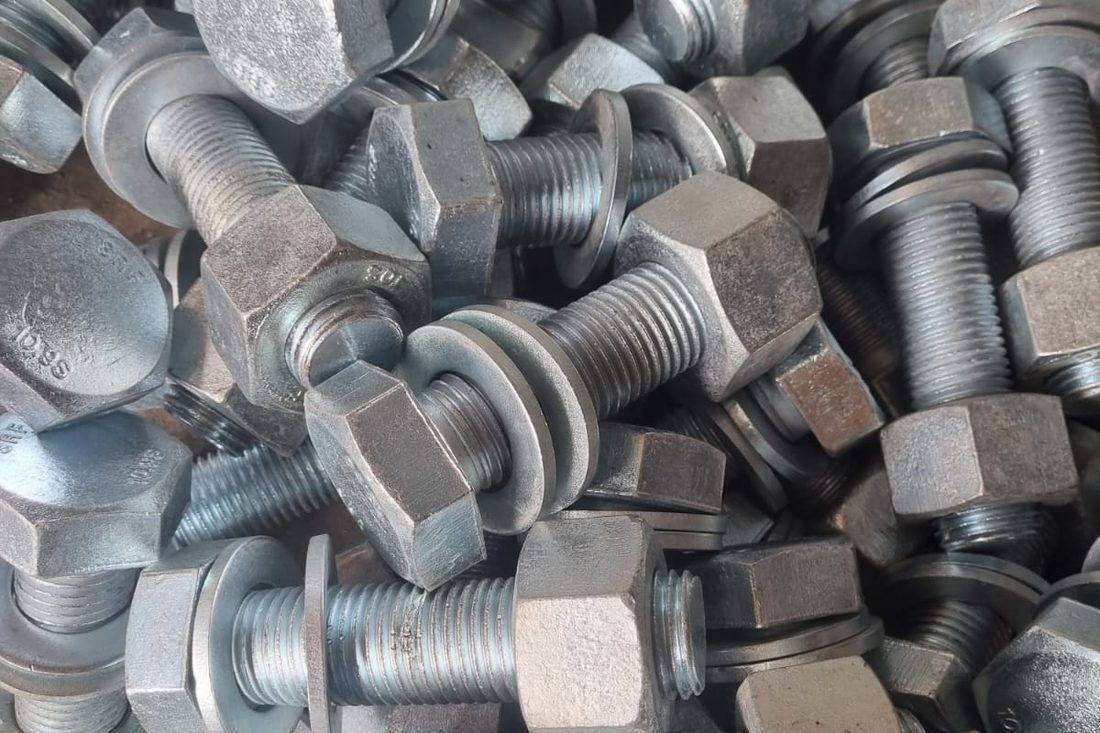
ISO 898-1 applies to coarse pitch thread M1.6 to M39. It stops there — which means that above M39, property classes 8.8 and 10.9 do not formally exist. A bolt stamped 10.9 at M48 is stamped to a standard that does not cover it. Two honest routes:
- Equivalent to class 10.9 — manufactured and heat treated to meet the 830 MPa proof stress and 1040 MPa tensile of class 10.9, with test certificates, but described as equivalent rather than compliant, because no standard grants compliance at that size.
- ASTM A354 Grade BC — A354 covers quenched and tempered alloy steel fasteners up to 4 in. diameter, and its own guidance is that above 1½ in. it is Grade BC that may be considered for structural steel. BC is roughly an 8.8-level material, not a 10.9, and unlike Grade BD it may be hot-dip galvanised.
- Not Grade BD, for preloaded work — A354 states that its fasteners are not to be used where they are tensioned above 50 % of their tensile strength, and directs those applications to structural heavy hex bolts instead. An HSFG bolt is preloaded to about 70 %, so Grade BD sits outside its own specification here however well its strength figures read. It remains a sound choice for high-strength bolting that is not preloaded.
Stress area is calculated from the ISO 898-1 formula As = (π/4) × (d − 0.9382 × P)², and proof load from stress area × proof stress: 600 MPa for 8.8, 830 MPa for 10.9. This method reproduces the IS 3757 published proof loads exactly at every size up to M36.
| Size | Stress area (mm²) | Proof load 8.8 (N) | Proof load 10.9 (N) |
|---|---|---|---|
| M36 | 817 | 490,200 | 678,110 |
| M39 | 976 | 585,600 | 810,080 |
| M42 | 1,121 | 672,600 | 930,430 |
| M45 | 1,306 | 783,600 | 1,083,980 |
| M48 | 1,473 | 883,800 | 1,222,590 |
| M52 | 1,758 | 1,054,800 | 1,459,140 |
| M56 | 2,030 | 1,218,000 | 1,684,900 |
| M60 | 2,362 | 1,417,200 | 1,960,460 |
For installation torque see our bolt torque calculator; for weights, the bolt weight calculator.
Can I have it fully threaded?
Yes — but only you can decide whether you should.
Where full thread is right: tension-only connections — base plates, hangers, tie rods — where there is no shear plane at all. Also where grip varies across a job and one length has to serve several thicknesses. In those cases full thread is often the better bolt.
Where it costs you: in shear or slip-critical connections, full thread puts threads in the shear plane, and the stress area is about 19% smaller than the shank area at every size on this page.
| Size | Shank area | Stress area | Reduction |
|---|---|---|---|
| M42 | 1,385 mm² | 1,121 mm² | 19% |
| M48 | 1,810 mm² | 1,473 mm² | 19% |
A fabricator who orders full thread because it is easier to source, into a connection the engineer designed on shank shear, has given away a fifth of his shear capacity without knowing it. We will supply either — confirm with your designer which condition the connection was checked for.
What coating can I have?
Self colour with anti-rust oil, electroplated zinc, hot-dip galvanising and zinc flake are all available, but the right answer depends on three things together — property class, bolt length, and the coating process itself. Some processes are length-limited. Some are restricted at high property class. Getting it wrong is expensive at these sizes.
Decide the coating and the specification together rather than one after the other. Send us the size, the property class and the length and we will tell you what is available and what we would recommend: info@srfastenersindia.com
What nut will I get?
Above M36 the nut is matched to the bolt head and supplied as part of the assembly rather than as a catalogue item, because the proof load has to match the bolt's actual property class and the across-flats has to match the head as made. We have not tabulated nut dimensions here for that reason.
Send us the bolt size and property class and we will send the matched nut specification: info@srfastenersindia.com
What washer?
ASTM F436/F436M covers hardened steel washers for fasteners with nominal thread diameters of 1/4 through 4 in. and M12 through M100 — the one component in the assembly where a live standard already covers the whole range and more.
F436M washers are specified for use with fasteners covered by A354, A449, A563, F959 and F3125, so the same washer standard serves an above-M36 metric assembly and an ASTM structural assembly alike. We supply to F436M, or to drawing where the application needs a non-standard outside diameter.
A plain washer is not a substitute. Under full preload a soft washer embeds into itself and into the ply, the joint relaxes and preload is lost — the connection stops being slip-critical even though every bolt was torqued correctly. Do not accept plain washers to IS 2016 in a preloaded assembly.
How do I tension an M48 bolt on site?
Plan for hydraulic tensioning, and decide it at design stage rather than on site. The part-turn tables that make torque-and-turn installation possible were established up to M36; above that they do not exist, and the preloads involved — about 1,030,000 N at M48 in 10.9 — are beyond what site wrenching will reliably and repeatably achieve.
If your erection method is fixed and cannot accommodate tensioning, tell us at enquiry stage. It may change the sensible answer to your connection.
What is the largest you make?
75 mm diameter on customised HSFG work, and extra long bolts to 2500 mm. Above M36 everything is made to drawing, so “standard size” stops being a useful idea. Send the drawing.
How we make them
- Material: EN18 for 8.8 across the range; 4140 for 10.9 above 27 mm
- Through hardened — quenched and tempered, not case hardened
- Heat treated in a 2 m deep pit-type gas-fired furnace with the bolts hanging vertically through the cycle, which is how long bolts come out of the quench straight
- Every lot tested twice: by the heat treatment house, and again by us on pieces drawn at random from the same lot and sent to a NABL-accredited laboratory
Standards referred to on this page
Every figure above is either taken from a published standard or derived from one, with the derivation shown. These are the documents behind it. We reproduce none of their tables — if you need the source data, buy the standard.
- IS 3757 — high strength structural bolts, M16 to M36. The parent of our dimensional rules.
- IS 6623 and IS 6649 — the matching high strength nuts and hardened washers.
- EN 14399-3 (System HR) and EN 14399-4 (System HV) — preloaded structural bolting assemblies, M12 to M36. The two thread length systems compared above.
- ASME B18.2.3.6M — metric heavy hex bolts, M12 to M36.
- ISO 4014 — hex head bolts, from which the across flats and nominal head heights are taken.
- ISO 898-1 — mechanical properties of bolts, screws and studs, coarse thread M1.6 to M39. The source of the stress area formula and the proof stresses.
- ASTM F3125 — high strength structural bolts, inch and metric, which absorbed the former A325 and A490.
- ASTM A354 — quenched and tempered alloy steel fasteners to 4 in. diameter, Grades BC and BD.
- ASTM F436 / F436M — hardened steel washers, 1/4 to 4 in. and M12 to M100.
- IS 4000 — code of practice for high strength bolts in steel structures, for installation and tightening.
If you think we have read one of these wrongly, write and tell us. We would rather correct the page than defend it.
Still have a question?
If you are specifying above M36 and something here does not match your drawing, tell us. We would rather have the conversation before the steel is cut. Send your drawing or your bolt list and we will come back with dimensions, weights and a quotation.
Email your drawing Ask on WhatsAppS R Forgings, E-615 Phase-VII, Focal Point, Ludhiana 141010, Punjab, India. Manufacturing high-strength structural fasteners since 2009. Dimensions above M36 on this page are S R Forgings manufacturing practice, derived from the rules IS 3757 follows below M36. They are not a published standard, because none exists above M36.