We make bolts every day, so one day I asked a simple question: when was the first bolt made? The answer surprised me. The idea behind the bolt is more than two thousand years old, but the bolt and nut as we know it, with threads that fit any matching nut, is only about two hundred years old. And some of that history is still on our shop floor in Ludhiana today.
The screw came before the bolt
The screw thread is usually traced to ancient Greece. Archytas of Tarentum, around 400 BC, is often credited with the idea, and Archimedes (287–212 BC) used the screw principle to lift water. The Greeks and Romans also built large wooden screw presses to squeeze olives and grapes for oil and wine.
None of these were fasteners. The Romans did use bolts, but as plain unthreaded bars to lock doors and as wedges. Holding two parts together with a threaded bolt and a nut came much later.
The first nut and bolt: the 1400s
The threaded bolt with a matching nut appears in Europe in the 15th century. Screws turn up in armour, in clocks, and in the printing presses of Johann Gutenberg. Every one of them was made by hand. A craftsman filed the thread on the bolt and cut a nut to suit it, so each nut fitted only its own bolt. Mix up two nuts and neither would go on.
Around 1500, Leonardo da Vinci sketched machines for cutting screw threads in his notebooks. Like many of his ideas, they were ahead of what the workshops of his time could build.
Machines arrive: 1568 to 1800
In 1568 the French engineer Jacques Besson built one of the first machines for producing bolts and screws. In 1760 the brothers Job and William Wyatt in England started a factory process to make screws in large numbers.
Mass production created a new problem. Every factory used its own thread, so a nut from one maker would not fit a bolt from another. The breakthrough came around 1800, when the English engineer Henry Maudslay built an accurate screw-cutting lathe. For the first time a thread could be copied exactly, again and again. Many engineers see this as the real start of the modern bolt and nut.
Standards: one thread for everyone
Accurate threads were only half the answer. The other half was agreeing which thread to use. This took more than a hundred years.
| Year | What happened | Still in use? |
|---|---|---|
| 1841 | Joseph Whitworth proposes a uniform British thread with a 55° flank angle: British Standard Whitworth (BSW) | Yes, on older machinery and some railway hardware |
| 1864 | William Sellers proposes a 60° thread in the USA, which becomes the American coarse and fine series | Its descendant, UNC/UNF, is used today |
| 1914–18 | Mismatched threads between allied countries cause serious supply problems in the First World War | — |
| 1919 | Germany develops the DIN metric thread | Led to ISO metric |
| 1948 | Britain, the USA and Canada agree on the Unified thread (UNC/UNF) for inch-series fasteners | Yes, across North America |
| Later | The ISO metric thread becomes the world standard | Yes, almost everywhere |
Why this history is still on our shop floor
Indian Railways was built on British practice. Rail sections such as 90R are named in pounds per yard, an imperial measure, and the fishplates and bolt holes were laid out in inches. That is why we still make 1-inch fish bolts for Indian track work, decades after India moved to metric for almost everything else.
BSW, Whitworth’s thread from 1841, is still on the list of threads we roll, alongside ISO metric, UNC, UNF and ACME. When one of our machines rolls a Whitworth thread, it is making a thread form that was first proposed in Manchester 185 years ago.
From rivets to high-strength bolts
For most of the 19th and early 20th century, steel bridges and buildings were held together with hot rivets. A crew heated each rivet red-hot, threw it up to the joint and hammered it closed. It was slow, noisy, dangerous work, and a poor rivet was hard to find and replace.
In 1947 the Research Council on Structural Connections was formed in the USA to prove that high-strength bolts could do the same job. Its first specification, in January 1951, accepted ASTM A325 bolts as a one-for-one replacement for structural rivets. Over the following decades bolts took over almost completely: they are faster to install, need smaller crews, and can be inspected and replaced.
A325 itself was withdrawn in 2016 and replaced by ASTM F3125, which today covers Grade A325 and A490 structural bolts. In Europe the same role is filled by EN 14399, and in India by IS 3757 HSFG bolts. We make HSFG bolts to all three standards, including 1½ inch F3125 bolts in A325 and A490. If you want to see where structural bolting is heading in India, read why pre-engineered buildings are moving to IS 3757 HSFG bolts.
India’s own bolt standards: IS 1363 and IS 3757
India wrote its own fastener standards through the Bureau of Indian Standards. Two of them cover most of the bolts on Indian steel structures, and both have their own story.
IS 1363: the everyday “black bolt”
IS 1363 covers hexagon head bolts, screws and nuts of product grade C. These are the forged “black bolts” used across general engineering, with wider tolerances than machined bolts. Its precision sibling is IS 1364, which covers product grades A and B.
- The standard has been revised several times. Earlier editions include 1984 and 2002, and the bolt part is now in its fifth revision (2019), which BIS says carried no technical changes.
- Over the years it was split into parts, for bolts, screws and nuts, and brought in line with the matching ISO standard for grade C bolts, ISO 4016.
- The bolt part covers M5 to M64. Strength classes, typically 4.6 for black bolts, come from IS 1367.
IS 3757: India’s HSFG bolt
IS 3757 is India’s standard for high strength structural bolts, the HSFG bolt. It is the Indian answer to the same question America answered with A325: how to replace rivets with a bolt that can be pretensioned.
- The edition in force today is IS 3757:1985, the second revision, with amendments in 1992 and 1998.
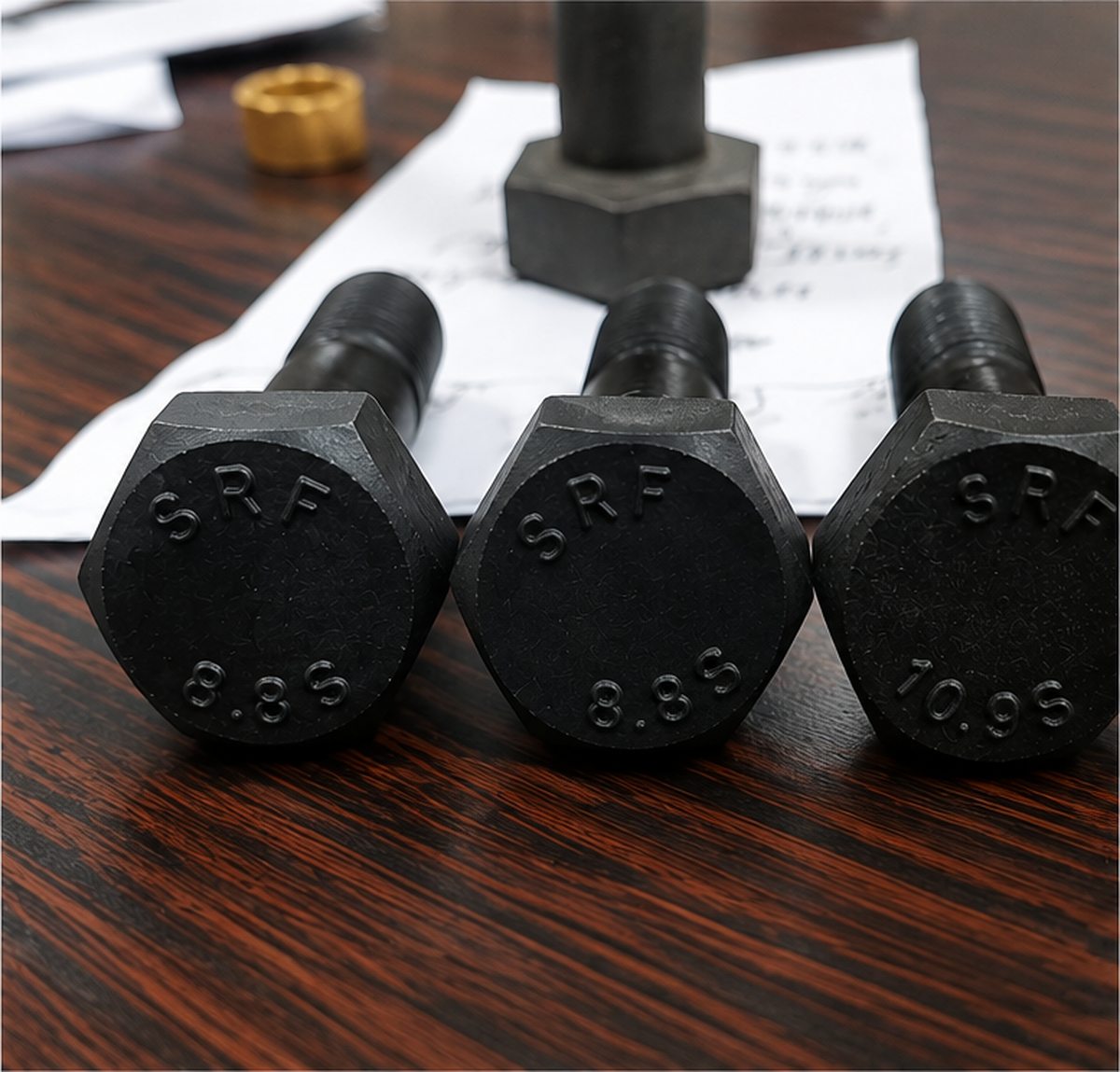
- It covers large-series hexagon bolts with short threads in property classes 8.8 and 10.9 (marked 8.8S and 10.9S), from M16 to M36, for both friction-type and bearing-type joints.
- It works as a family: IS 6623 nuts, IS 6649 hardened washers (revised the same year, 1985), and IS 4000 for how the bolts are installed and tightened.
- The bolt is designed so that, with its matching nut, it gives a high level of assurance against thread stripping when overtightened, which is why the nut and washer must come from the same matched assembly.
A standard written in 1985 still governs the HSFG bolts going into India’s metros, data centres and pre-engineered buildings in 2026. In that time Europe moved to EN 14399 and America to ASTM F3125. The M36 upper limit of IS 3757 is also why we now get enquiries for 39 mm heavy head bolts that the standard does not cover. With HSFG bolts now under a government Quality Control Order, IS 3757 matters more today than at any time since it was written.
What comes next
The bolt is not finished changing. Three trends are already visible in structural work:
- Easier, checkable tightening. Direct tension indicator (DTI) washers show when a bolt has reached its tension, and tension control (twist-off) bolts snap off a splined tail at the right load, so an inspector can check a joint by eye.
- Bigger and stronger bolts. Wind turbines, longer bridges and heavier industrial structures need larger diameters and longer lengths every year.
- Bolted, not welded. Structures that can be taken apart and reused are gaining ground, and a bolted joint can be undone where a weld cannot.
Small screws in cars and electronics are being replaced by castings, adhesives and clips. Heavy structural bolts are moving the other way: the more we build bridges, railways, power plants and wind farms, the more of them the world needs.
Quick answers
When was the first bolt made?
Threaded bolts with matching nuts appear in Europe in the 15th century. The screw thread itself is much older, going back to ancient Greece around 400 BC.
Who invented the modern nut and bolt?
No single person. Henry Maudslay’s screw-cutting lathe of around 1800 made accurate, repeatable threads possible, and Joseph Whitworth’s 1841 thread standard made bolts and nuts from different makers fit each other.
Which edition of IS 3757 is current?
IS 3757:1985, the second revision of the Indian standard for high strength structural bolts, with amendments issued in 1992 and 1998. It covers property classes 8.8 and 10.9 from M16 to M36.
What replaced rivets in steel structures?
High-strength structural bolts. The first specification accepting ASTM A325 bolts in place of rivets was published in 1951, and bolts have been the normal choice ever since.
Need a bolt that history has not standardised yet?
From 1-inch fish bolts to M75 studs and heavy head HSFG bolts, we make fasteners to your drawing in Ludhiana. Send us the drawing or the size, and we will reply the same day.