For years a pre-engineered building in India went up on ordinary 8.8 hex bolts. That is changing. More and more PEB drawings now call for HSFG bolts to IS 3757, supplied as matched assemblies with IS 6623 nuts and IS 6649 hardened washers. At the same time we are getting a new kind of enquiry: 39 mm heavy head bolts, a size IS 3757 does not cover. This article explains why PEB — and new thermal power plants — are moving to HSFG, what the heavy head actually does, why standard bolts are still right for some work, and how an M39 heavy head bolt is made when the standard runs out.
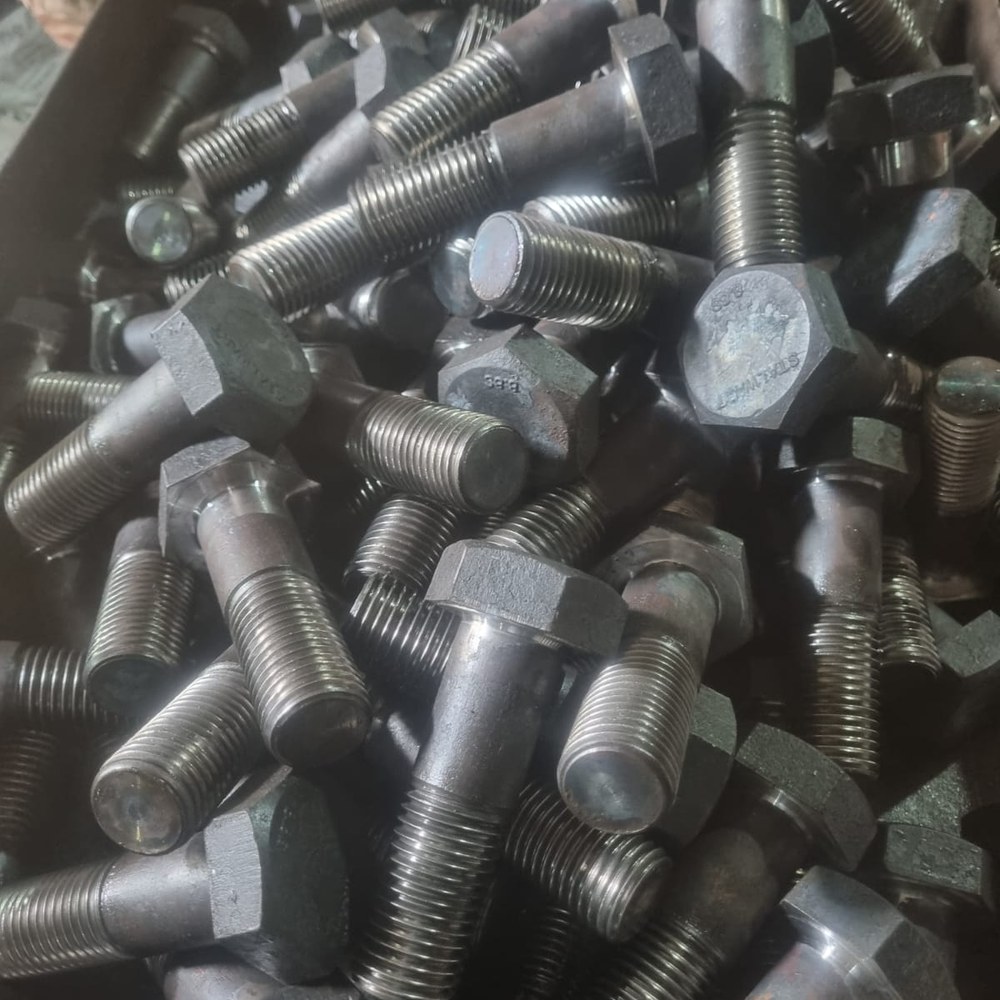
What has changed in PEB
The early PEB market was warehouses and factory sheds: light portal frames, modest spans, few cranes. Ordinary 8.8 hex bolts, snug-tightened, did the job, and the connection was designed as bearing type.
Today's PEB jobs are heavier. Data centres carry racks, chillers, generators and cable containment. Warehouses are taller, with mezzanines and crane runways. End-plate moment connections carry large tension and shear together, and many of the owners are international companies whose consultants write their own bolting specifications. Once the connection has to be pretensioned, or designed as slip-critical, an ordinary hex bolt is the wrong part.
Why IS 3757 HSFG bolts instead of standard bolts
An HSFG bolt and a standard 8.8 hex bolt can have the same diameter and the same property class number, but they are different products.
| Standard hex bolt | HSFG bolt to IS 3757 | |
|---|---|---|
| Bolt standard | IS 1364-1 (ISO 4014), properties to IS 1367 | IS 3757, classes 8.8S and 10.9S |
| Nut | Regular hex nut | Heavy HSFG nut to IS 6623 |
| Washer | Plain washer | Hardened washer to IS 6649 |
| Head | Standard hex head | Larger structural head, wider bearing face |
| Thread length | Longer | Shorter, so the plain shank sits in the shear plane |
| Marking | 8.8 or 10.9 | 8.8S or 10.9S, plus maker's mark |
| Connection type (IS 800) | Bearing type, snug-tight | Friction type (slip-critical) or pretensioned bearing type |
| Supplied as | Loose bolts, nuts and washers | Matched bolt, nut and washer assembly |
The reasons PEB designers are making the switch come straight out of that table:
- Pretension needs a matched assembly. A friction-type connection to IS 800 depends on the bolt being tightened to about 70% of its tensile strength. A regular nut on a standard bolt is not designed to take that load reliably. The heavier IS 6623 nut and hardened IS 6649 washer are.
- No slip under load reversal. In crane buildings and anywhere with wind or vibration, a slip-critical joint does not move, so holes do not elongate and nuts do not work loose.
- Shank in the shear plane. The shorter thread keeps the full-diameter shank where the shear is, not the threaded section.
- Inspection is easier. The "S" marking tells a site inspector or third-party auditor at a glance that the right bolt went in. International clients ask for exactly this.
For a full comparison of IS 3757 with EN 14399 and ASTM F3125, see IS 3757 vs EN 14399 vs F3125.
What the heavy head actually does
The structural head is visibly bigger than a standard hex head — at M20, 32 mm across flats against 30 mm. That extra size is there for a reason.
- It spreads the preload. A tightened M20 10.9 bolt clamps with roughly 170 kN. A larger bearing face lowers the pressure on the plate, so the head beds in less, coatings crush less, and less preload is lost after tightening. With a hardened washer it also bridges oversize and slotted holes.
- It takes the tightening. Pretensioning needs high torque or a measured part-turn of the nut. A wider hex gives the spanner more to grip, so heads and nuts do not round off.
- It works with a heavy nut. The IS 6623 nut is larger and stronger than a regular nut, so under full preload the bolt stretches before the threads strip. A strip failure gives no warning; a stretched bolt does.
- It is easy to check. On a site with thousands of bolts, an inspector can tell a structural head from a standard one at a glance, before even reading the 8.8S or 10.9S marking.
So why are standard bolts still used?
Because for a lot of steelwork they are the right bolt.
- The connection does not need pretension. Purlins, girts, cladding rails, platforms, handrails and ladders are bearing-type joints, tightened snug. A standard 8.8 bolt does that job fully.
- Cost and availability. Standard bolts are cheaper and sit in traders' stock in every length. The longer thread lets one length cover a range of grips.
- The drawing says so. Many designs, older ones especially, were calculated as bearing type and call for standard bolts.
The rule is simple: the bolt follows the connection design. Where the design is bearing type, standard bolts are correct. Where it is friction type or pretensioned, only an HSFG assembly will do — and swapping one for the other is the designer's decision, never the site's.
Thermal power plants are making the same shift
We supplied standard high tensile bolts for the Barauni thermal power project in Bihar. The drawings called for them, and they were the right bolts for that design.
New thermal units are being specified differently. Boiler supporting structures, mill and bunker buildings, coal handling galleries and turbine halls with EOT cranes all carry vibration from mills, fans and conveyors, repeated crane loads, and temperature swings. In steelwork like that, a joint that slips even slightly will work loose over the years, so the main connections are designed slip-critical and the bolts become HSFG assemblies. The enquiries we now receive for mill bunker building steelwork are for HSFG 10.9S assemblies from M16 to M36, with matched nuts and hardened washers.
Plants built by international EPC contractors, or to European or American specifications, call for the same kind of assembly under a different standard: EN 14399 (HR or HV systems) or ASTM F3125 Grade A325 and A490. How the three standards compare, and which coating to choose, is covered in HSFG Bolts Explained: IS 3757, EN 14399 and ASTM F3125. We make HSFG assemblies to all three standards — see HSFG and high tensile bolts.
The M39 problem: where IS 3757 stops
IS 3757 covers M16 to M36, and the matching nut and washer standards stop at the same place. As PEB frames get heavier, connection designs are now reaching past M36, and the enquiries we receive say "39 mm heavy head bolt" because there is no standard designation to write instead.
There is nothing wrong with an M39 bolt. What is missing is a published table that fixes its head, thread length, nut and washer. So the buyer and the manufacturer have to fix them on the drawing before production starts.
How we make an M39 heavy head bolt
There are three ways to supply a bolt at this size. The first two are made to drawing; the third stays inside a published standard.
1. Structural head proportions carried on to M39
The IS 3757 head pattern is extended to the next size. This is the version most buyers mean.
| Head across flats | 63.10 to 65.00 mm |
|---|---|
| Head height | 23.95 to 26.05 mm |
| Thread length | 59 mm for bolts up to 100 mm long; 66 mm above 100 mm |
| Proof load | About 585,600 N in 8.8; about 810,080 N in 10.9 |
| Pretension (0.7 × nominal tensile strength × stress area) | About 547 kN in 8.8; about 683 kN in 10.9 |
Dimensions for M42 to M60 are in our article on HSFG bolts above M36.
2. Head taken from the next size up
Where the connection needs more bearing area, or the buyer wants a margin over the structural head, we forge the head to the dimensions of the next size up on the M39 shank. We used the same approach on M42 bolts for a data centre built by a PEB and EPC contractor: a 45 mm size head on a 42 mm thread, in 10.9S, supplied with matched nuts and washers. More on that sector on our data centre bolts page.
3. Stay inside a standard: 1½ inch ASTM F3125
If you would rather not go outside a published standard at all, there is a third route. ASTM F3125 covers heavy hex structural bolts up to 1½ inch, which is 38.1 mm — within a millimetre of M39. Head, thread length, nut (ASTM A563 DH or A194 2H) and hardened washer (ASTM F436) are all fixed by the standard, so nothing has to be invented on the drawing.
It is close to M39, but not identical, so the designer has to check it:
| M39 (made to drawing) | 1½ inch ASTM F3125 | |
|---|---|---|
| Diameter | 39 mm | 38.1 mm |
| Thread | Metric coarse, 4 mm pitch | UNC, 6 threads per inch |
| Tensile stress area | 976 mm² | 906 mm² (1.405 in²), about 7% less |
| Head across flats | 63.10 to 65.00 mm | 2⅜ inch (60.3 mm) |
| Pretension, lower grade | 8.8: about 547 kN | A325: 103 kips (about 458 kN) |
| Pretension, higher grade | 10.9: about 683 kN | A490: 148 kips (about 658 kN) |
In practice: A490 at 1½ inch comes within about 4% of an M39 10.9 on pretension, while A325 is about 16% below an M39 8.8. Holes drilled 42 mm for M39 leave 3.9 mm clearance on a 1½ inch bolt, a little more than the 3.2 mm of a standard ASTM hole, which matters for a slip-critical joint. Site crews will also need inch sockets and inch tightening values. The swap is the designer's decision, and it should be approved in writing before the order is placed — but when it is approved, the whole assembly is to a published standard. We make 1½ inch F3125 bolts in both Grade A325 and A490.
Material, nuts and washers
- Material. At 39 mm, 8.8 is made in EN18 and 10.9 in 4140. A plain carbon or boron steel will not harden through to the core at this diameter. See what steel goes into an 8.8, 10.9 or 12.9 bolt.
- Heat treatment. Quench and temper in a gas-fired pit furnace, with every lot tested by the heat treater, and two more pieces from the same lot verified at a NABL-accredited lab.
- Nuts. IS 6623 stops at M36, so the M39 nut is a heavy hex nut matched to the bolt's property class and supplied as part of the assembly.
- Washers. Hardened washers to suit, never plain washers under a pretensioned bolt.
What to put on an M39 heavy head enquiry
- Diameter and property class — M39, 8.8S or 10.9S.
- Head — structural proportions extended to M39, the next size up, your own drawing, or 1½ inch ASTM F3125 if the designer has approved it.
- Length and grip — overall length, or the plate thicknesses being joined.
- Assembly — bolt only, or bolt with nut and how many washers.
- Finish — black, or the coating your specification calls for.
- Testing — any third-party inspection or test certificates required.
- Quantity and delivery — pieces per size and the site or port.
For indicative tightening torque at any size, use our bolt torque calculator, and for consignment weight, the bolt weight calculator.
Have a question about PEB bolting?
If your PEB drawing calls for a size or head the standard does not cover, send it to us. Ask us anything about HSFG bolts in PEB work — we answer every question, and the good ones become our next article.